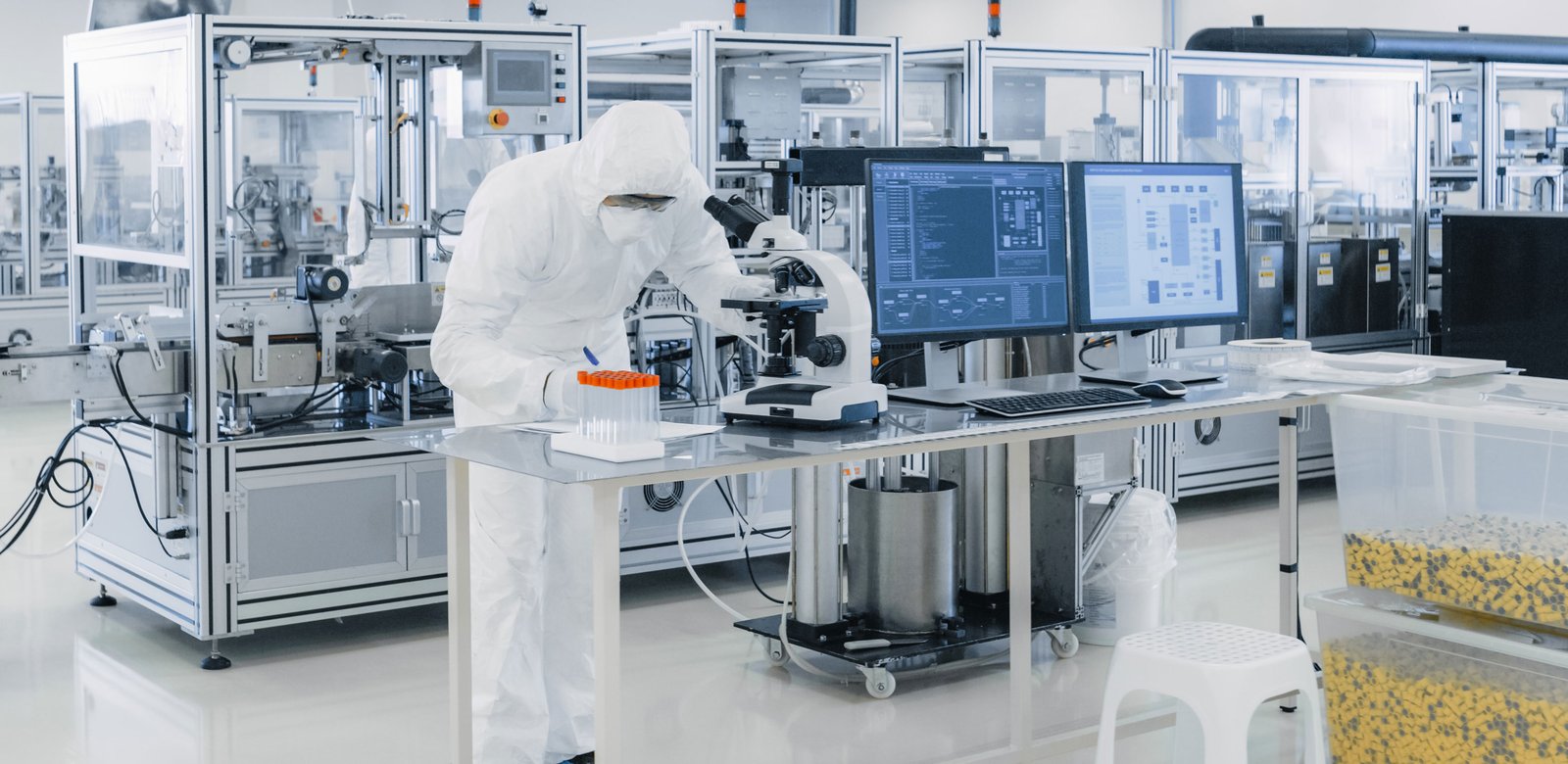
Pressure cascades and particle counts decide whether a pharmaceutical room passes, and neither can be fixed with a punch list. We build manufacturing, packaging, laboratory and support space for life sciences owners in New Mexico, and we treat the mechanical and finishing sequence as the center of the schedule, with the structure as the frame that carries it.
New Mexico's strength for this work is its science and engineering base. Sandia National Laboratories reports a fiscal year 2025 workforce of 16,320 and a total budget of $5.8 billion, and Los Alamos National Laboratory reports a workforce of about 14,150 and almost 900 individual facilities. Companies with a technical product, the same kind of buyer we describe under advanced manufacturing, whether a compounding operation, a diagnostics maker, a device assembler or a clinical supply group, can draw on that talent, and they often choose to build near it.
The people who contact us are quality heads, engineering directors and owners' representatives. They want to know how a contractor will protect classified space from dust, how documentation will be kept and when the commissioning agent is invited. We answer in order: preconstruction, controlled construction, verification, handover. Our trade partners follow written procedures for each stage, and we keep records the quality unit can audit.
Which Codes Apply and What Reviewers Ask For
The 2021 New Mexico Commercial Building Code adopts the 2021 International Building Code as amended and took effect July 14, 2023. The Regulation and Licensing Department lists the 2024 New Mexico Plumbing Code and the 2024 Mechanical Code as effective August 1, 2026, with permits issued under either the 2021 or 2024 edition until January 1, 2027 and only the 2024 edition after that. For a controlled environment with heavy mechanical content, that transition matters, and we ask the design team early which edition each permit will use.
Beyond the building codes, regulated product rooms follow the owner's quality standards and the applicable federal manufacturing rules, which the owner's consultants interpret. Our role is to build to the drawings and specifications, document the work, and avoid changes that would send a validated area back through review. Hazardous materials storage, solvent handling and exhaust require their own fire and environmental review, so we submit those drawings as a separate package.
Building Clean From the Slab Up
A controlled space is built in a particular order. The envelope is closed and dry before any finishes begin. Mechanical rough-in follows, then ceilings, then walls and floors with sealed joints, and last the fixtures. We keep crews out of finished rooms except for authorized tasks, and we use sticky mats, controlled entry and daily cleaning of the area to keep dust from spreading. Each handoff between trades is recorded so that the owner knows who worked in a room and when.
Preconstruction is where a project is won or lost, so our preconstruction services include mock-up reviews, submittal sequencing, and a long-lead list that covers air handlers, isolators, clean steam equipment and controls. We also run constructability reviews on the critical rooms to check that ducts, sprinkler pipes and cable trays fit above the ceiling without collisions.
What We Manage Most Closely
We closely supervise site work, foundations, slabs, structural steel or tilt panels and the building envelope. For a clean facility, the slab and the envelope are especially important: a flat, crack-resistant slab with the right sealer carries the epoxy finish, and a tight envelope reduces the load on the air handling system. The same crews build equipment pads, housekeeping pads and the utility yard for chillers, boilers and generators.
Specialty trades such as cleanroom panel systems, process piping and validation are performed by qualified subcontractors that we schedule and supervise. A dedicated superintendent oversees the whole project and leads weekly meetings with the owner, the quality group and the commissioning agent. For a view of the plant types we can deliver, see our work on pharmaceutical manufacturing facilities and the manufacturing plant page.
Permit to Work in a Controlled Building
The safety plan has to protect both people and product. Hot work, welding and grinding near controlled spaces are scheduled with the owner and restricted by permit to work. Lockout and tagout is used for every tie-in to existing utilities, and any work in a live laboratory requires a briefing about the materials in the room. When the building is next to a research campus, the owner's security group may also control access, so we plan deliveries, badging and escorted entry in advance.
We keep a record of every site visitor, every hazardous material brought onto the project and every inspection. Waste from demolition and finishing is characterized and removed in accordance with the permits. The commissioning phase, which includes testing and balancing, qualification support and training, is described in more detail under commissioning, turnover and closeout.
Where Life Sciences Work Can Land
The most natural fit for a technical product is near a major research employer. Albuquerque sits in the Rio Grande rift, a valley bordered by faults that lifted the Sandia and Manzano Mountains, with elevations from about 4,900 feet near the river to more than 6,700 feet in the foothills, and it is the base for Sandia and Kirtland Air Force Base. Los Alamos is reached by NM 4 and NM 502 only, which affects delivery planning for any project there, and Espanola residents rely on the laboratory for more than 12 percent of local employment.
Owners who are not tied to a campus can choose a site on I-25 or I-40 and rely on the interstate network. Whatever the location, the same discipline applies: clean construction, documented commissioning and a handover the quality unit can accept. If your product line also involves food-grade or beverage manufacturing, our page on food and beverage explains the sanitary finishes that overlap.
Bring Us the Room List
Send your room classifications, utility needs and commissioning plan, and we will return a controlled-construction sequence with a schedule your quality group can review.
Common Questions
Do you build GMP spaces?
We build the structure, envelope, site, and the general construction of controlled rooms, working with specialty subcontractors for cleanroom systems and with your consultants for validation. The quality requirements come from your design team. Our job is to deliver the drawings accurately and to document how we did it.
How do you protect a cleanroom from construction dust?
We close the envelope first, isolate work zones with temporary walls, run negative air in dusty areas, and use controlled entry with sticky mats. Finished rooms are locked and accessed only for approved tasks, and cleaning is done daily.
What changes with the 2024 plumbing and mechanical codes?
The state lists the 2024 plumbing and mechanical codes as effective August 1, 2026, with permits allowed under either the 2021 or 2024 edition until January 1, 2027. We confirm early which edition each permit will use so the design and the procurement agree.
Can you renovate an existing building into a lab or production space?
Yes. We begin with a survey of the structure, mechanical capacity and electrical service to see what the building can carry, then identify the limits on roof loads and floor vibration. Many conversions work better than expected, and some do not, and an early survey tells you which you have.
Who owns the commissioning documentation?
The owner does. We assemble the construction records, test data and as-builts in the format your quality unit specifies and hand them over with the building.
Related
Related Services
Related Building Types
Related Industries
Related Service Areas
Ready to talk about your project?
Request a Project ReviewOne project team for the whole sequence
Industrial Contractors of New Mexico reviews the site, the loads, the schedule and the approvals before pricing, then schedules, coordinates and inspects the specialty trade partners from preconstruction through closeout.