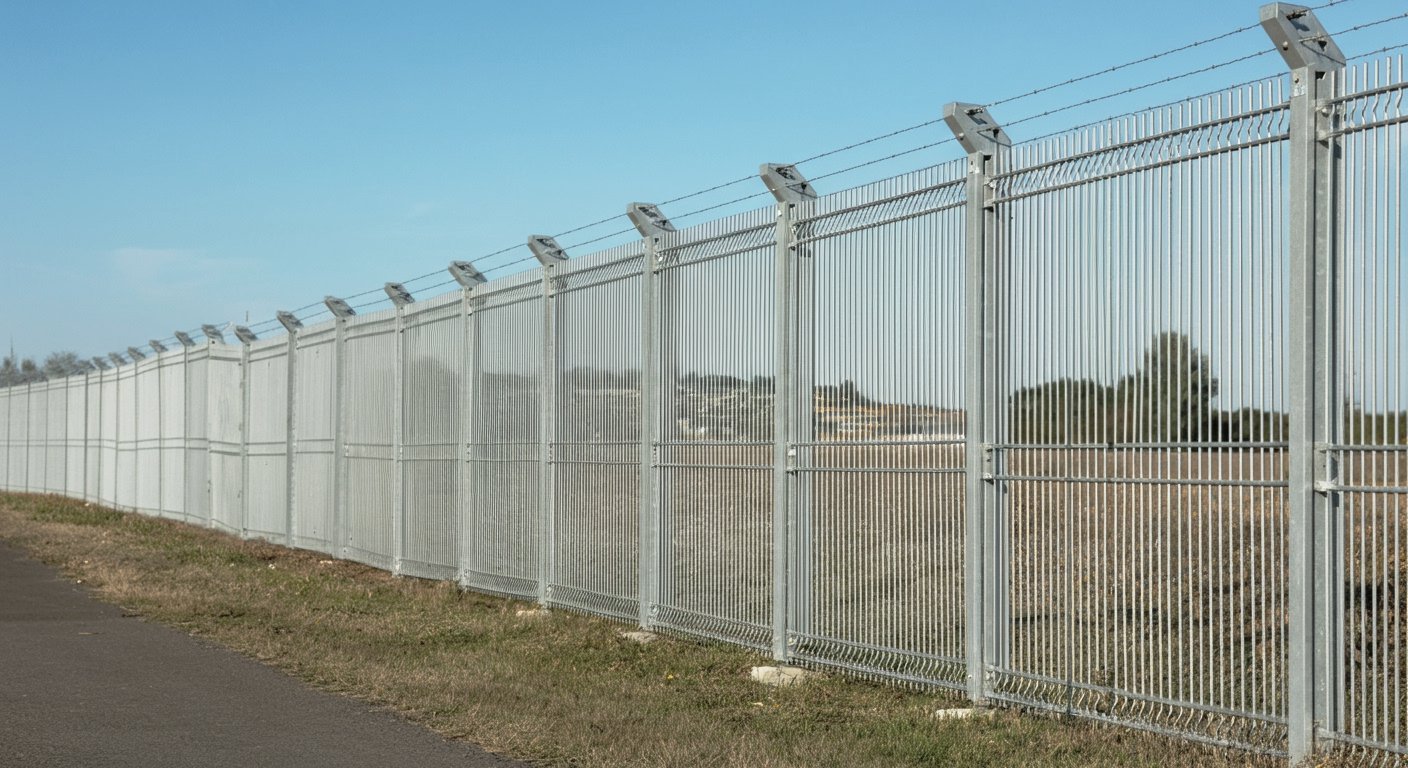
Gate placement controls everything else about a secured perimeter, from truck queues to emergency access. Put the truck gate too close to the public road and trailers stack onto the shoulder while the guard checks paperwork near the truck court. Put it too far and you have bought a long stretch of fence that does nothing. We start every fencing and security project by walking the way a truck, an employee, a visitor and a fire engine would each enter the property, and we set the gates.
Our work covers the physical perimeter and the civil base for the electronics that sit on it: chain-link and ornamental fence, vehicle gates and operators, pedestrian gates and turnstile pads, bollards, guard shelters, conduit and fiber paths, and the concrete for cameras, card readers and intercoms. A low-voltage integrator, selected by the owner, installs and programs the security electronics. We build the foundations, sleeves and power they need and keep the schedule so they are not waiting on a pour.
For the owner, the steps are a security survey, a gate-and-queue layout, review by the owner's security group, construction, device installation and a commissioning walk where every gate is cycled and every camera view is checked.
Site conditions that change a fence plan
New Mexico sites bring particular problems. Wind loads on solid screening and on large gates are higher than the plan sometimes assumes, so footings are sized for the exposure, and screening slats are chosen with open area when the owner wants to limit load. Soil conditions vary from loose sand to cemented caliche, which affects whether post holes are drilled or augered and whether footings need extra depth.
Arroyos and drainage channels cut across many industrial parcels. A fence that blocks a channel will catch debris in a storm, then fall or dam the flow. We place flow-through sections or break-away panels where the fence crosses drainage, and we coordinate the details with the site drainage design. Property lines in rural areas can be uncertain, so we confirm them by survey before setting the first post.
Perimeter, gates and the base for the electronics
We install fence in the heights and fabrics the security plan calls for, with top rails, tension wire, bottom rails where needed, and outriggers or top rails if the owner wants added deterrent. Vehicle gates are cantilever slide gates or swing gates, selected by the available space and the speed of operation. Each gate sits on a reinforced concrete track or slab, with loop detectors cut into the pavement and safety edges at the leading face.
Bollards at the building face and at the pedestrian entrances protect people and equipment. Where the owner needs crash-rated barriers, we install the manufacturer's tested system to the foundation detail the manufacturer provides and do not substitute another. Guard shelters, pedestrian turnstile pads, camera pole foundations, conduit, duct bank and fiber pull boxes are all built into the same package, and the as-built drawings show every sleeve and pull box.
Access control for everyone on our site
A secured site is a place where everyone on our site must be controlled as well. We submit names and vehicle information as the owner requires, escort or badge workers as the site demands, and keep tools and materials inside the work area. Some facilities restrict photography, devices and vehicle types, and everyone on our site is briefed on those rules at the gate on their first day.
The work itself carries hazards that we manage with a written plan: trenching near unknown lines, operating gates under construction, and lifting posts and panels in wind. When we cut into an existing fence line, we keep the opening staffed, or closed with a temporary barrier, so that the perimeter is never left open overnight. Nothing is energized until the integrator and the owner's security lead have signed the commissioning checklist.
Sequencing gates, power and commissioning
Electrical gate operators, card readers and cameras need power and data in conduit before the pavement goes down, which is the same trench discipline described under yard lighting and electrical site work. The sequence we follow is survey and layout, underground sleeves and conduit, footings, fence and gate frames, paving, device installation, then integration and commissioning. Long-lead items such as crash-rated barriers and custom gates are ordered as soon as the owner approves the layout.
On an active site, the perimeter has to stay closed while work proceeds, so we build it in segments. A new fence is stood up inside or beside the old line, the cut-over is done in one shift, and the old line is removed afterward. We coordinate the cut-over with the owner's security desk and the fire authority so emergency access is never blocked.
Secured sites we understand across the state
New Mexico has several kinds of sites where the perimeter matters. Kirtland Air Force Base contributed $7.5 billion to the local economy in fiscal year 2024 and hosts more than 20,000 military and civilian personnel, and Los Alamos National Laboratory reports almost 900 individual facilities on almost 40 square miles of DOE-owned property. We do not discuss any owner's programs, only the facility requirements that come with them. Work near Los Alamos includes a long approach on the state routes, so deliveries must be scheduled with that in mind. Data center campuses present a different case, since their perimeters stack a fence, a vehicle barrier and camera coverage in layers.
Along the border, the Santa Teresa Port of Entry sits beside the Gateway Rail Park, and owners in Santa Teresa run yards with truck gates and inspection areas that need fence and lighting designed together. Warehouse and fulfillment owners, such as those in e-commerce fulfillment, and data center operators add camera coverage and access control.
Walk the entry route with us
Send us the site plan and the security requirements. We will walk the truck, employee and emergency routes, propose gate locations and give you a layout and price for the perimeter.
Common Questions
Where should the truck gate be placed on a plant site?
It should be set back far enough that the longest truck you receive can stop at the gate without blocking the public road. We measure the trailer length, add room for the guard's check and sketch the queue on the plan. The result is usually deeper than owners expect. The gate must also not conflict with the fire access route.
Do you install the cameras and card readers?
The owner's low-voltage integrator installs and programs them. We build what they depend on: poles, foundations, conduit, power, pull boxes and gate hardware pads. We schedule the integrator's access so their work does not wait on ours, and we join the commissioning walk.
Can you replace a fence while the plant is running?
Yes, in segments. We stand up the new line beside the old, cut over in one shift with the security desk informed, and then remove the old line. The perimeter is never left open overnight, and emergency access stays clear.
How do you handle fence crossings at arroyos?
We use flow-through or break-away sections, designed with the drainage engineer, so the fence does not block or catch debris in a storm. These sections are inspected after major rain events. Fixed fence on each side stays in place.
What wind loads do gates and screening need to withstand?
That depends on the site exposure and on how solid the screening is. Open-area slats and perforated panels reduce load. We size footings and posts for the design wind speed and for the gate leaf's area, and we confirm the manufacturer's requirements before ordering.
Related
Related Services
Related Industries
Related Service Areas
Ready to talk about your project?
Request a Project ReviewOne project team for the whole sequence
Industrial Contractors of New Mexico reviews the site, the loads, the schedule and the approvals before pricing, then schedules, coordinates and inspects the specialty trade partners from preconstruction through closeout.