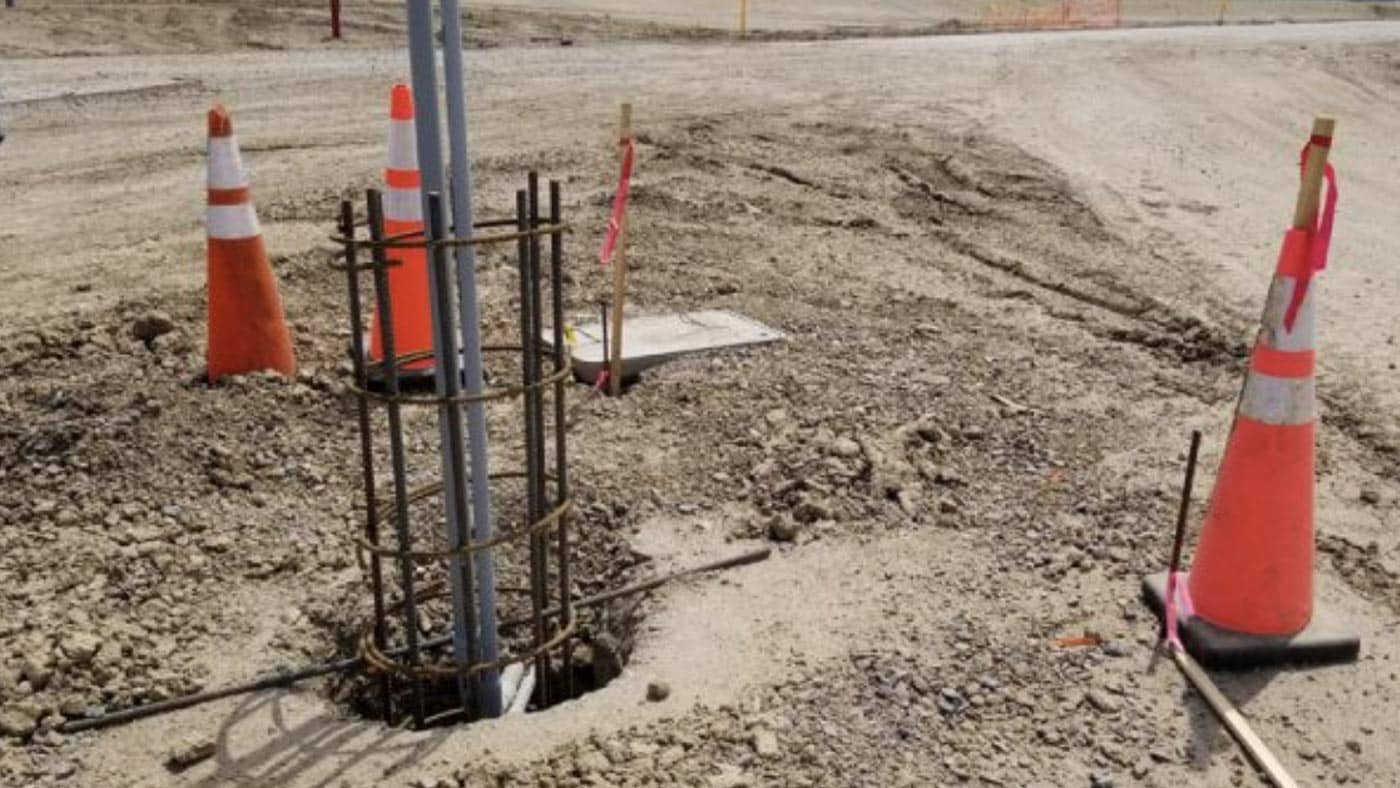
At 5:30 on a winter morning the first shift is already walking across the yard, and the only thing between them and a backing truck is the lighting. Industrial owners tend to treat yard lighting as the last item on the site plan. We treat it as a safety system that has to be designed, trenched and energized before the first employee walks the property, and that has to keep working through wind, dust and a summer of afternoon storms.
Our yard lighting and electrical site work covers the whole path from the utility transformer to the fixture: conduit and duct bank, pull boxes, pole foundations, poles and luminaires, controls, and the branch circuits that serve gate operators, cameras, card readers and yard receptacles. Licensed electricians pull the wire and make the terminations under the permit. We build everything that gets them there on time, including the trenching, the concrete and the restoration of paving and landscaping afterward.
For the owner the experience is a short list of decisions: the lighting levels required in each area, who owns the pole and the meter, the control strategy, and the date the system must be energized. We put those decisions on one page before work starts.
From transformer pad to luminaire
The scope begins with a photometric layout that shows light levels over the truck court, the parking, the gate and the walking routes. Higher mounting heights and fewer poles cost less in trenching, while lower poles give better control of spill light at the property line. Local outdoor lighting ordinances, including dark-sky provisions in some jurisdictions, may limit fixture type and shielding, so we review those rules before ordering.
Underground work follows: trenching to the depth shown, conduit with spare ways, pull boxes at changes of direction, and warning tape above the line. Poles are set on drilled concrete foundations sized for the wind load and the soil at that location, with anchor bolts held in a template so the pole sits plumb. The control scheme, whether photocell, timeclock or a networked system, is set up and tested at night before turnover.
Electrical code, inspections and utility coordination
The 2020 New Mexico Electrical Code (14.10.4 NMAC) adopts the 2020 National Electrical Code as amended and took effect March 28, 2023. Permits could be issued under either the prior or the new rule until September 28, 2023, and only under the new rule after that. Any yard lighting or site electrical job permitted now falls under the 2020 edition, and our electrical subcontractors submit and close out their permits on that basis.
Utility coordination takes longer than most owners expect. The serving utility has its own application, its own design review and its own lead time for transformers and meters. We start that conversation during preconstruction, tied to the larger site utilities package, and we hold the trench open or sleeved for the utility's crew when their schedule requires it.
Working around energized lines and operating plants
Digging near electrical lines is the largest hazard in this scope. Every trench begins with a one-call locate request and a review of the owner's own drawings, followed by potholing to expose existing lines before machines go near them. Equipment operators receive a briefing on overhead clearances, and a spotter is posted wherever a lift or an excavator works beneath or beside a line.
On an operating site the work runs under the owner's permit to work. Lockout and tagout of any circuit we touch is performed by the owner's electrician or under the owner's written procedure, and no one on our site opens a panel that belongs to the plant. When the system is energized, we do it with the owner's representative present and test each circuit and control before signing off.
Where lighting overlaps other site scopes
Lighting is easiest to build when it is planned with the paving. Conduit sleeves under a truck court, pole bases inside an island, and handholes at the edge of a fence line are all cheaper before the surface exists. That is why we coordinate with fencing and security integration for cameras and gate power, and with underground electrical duct banks when the circuits are large.
The same coordination applies at the energy end of the state. PNM said on Sept. 30, 2022 that the last unit of its coal-fired San Juan Generating Station had been removed from service, which leaves large electrical sites near Farmington with questions about reuse and new supply. Utility and power owners are familiar with the terms; we help them with the civil and conduit work around those decisions.
Fitting the energize date into the schedule
Luminaires, poles and controls can have long lead times, so the order is placed as soon as the layout is approved. Foundations are poured when the poles are confirmed to ship. Wire is pulled after the paving base is in and before the final lift, so a conduit failure can be fixed without cutting new pavement.
The Las Cruces Innovation and Industrial Park shows why that sequencing matters. The city lists more than 400 acres shovel ready, with another 500 acres available for lease or purchase, in a park that is covered by Foreign Trade Zone 197 and sits at the junction of I-10 and I-25. A new tenant there needs power and lighting working on the day the building is occupied, so the electrical civil work goes in with the first utilities and not after the building. We hold a final night walk with the owner, record any dark spots and fix them before turnover.
Set the lighting levels before the trench is open
Send us the site plan, the serving utility and the hours your yard runs. We will prepare a lighting and conduit layout, identify the utility steps with the longest lead time and price the work in a form you can compare.
Common Questions
Do you install the wiring or only the conduit and poles?
Licensed electricians pull the wire and make the terminations under the electrical permit. We build the trench, conduit, foundations, pole setting and restoration, and we coordinate the electricians so the work fits the paving schedule. The owner has one point of contact and one schedule.
How bright does a yard need to be?
That depends on what happens in each area. Truck courts, gates and walkways need more light than storage areas, and the owner's safety group usually sets the targets. We prepare a photometric layout to show the levels before the poles are ordered, and we check light levels at night before turnover.
Can we reuse existing poles and wiring?
Sometimes, after testing. We inspect the poles, foundations and conduit and test the circuits. Old wire in damaged conduit is a common cause of outages, and replacing it while the trench is open costs less than repairing it later. We give the owner a list of what can stay and what should go.
What delays power to a new site the most?
Utility lead times, usually. The serving utility has its own application and design process and a lead time for transformers and meters. We file early, track each step and keep the trench and sleeves ready so the utility's crew can connect on their date.
Can lighting be added after paving?
Yes, but it costs more. Cutting pavement for conduit and boring under existing surfaces adds time and leaves visible patches. If lighting is likely to be added later, we recommend setting sleeves and pole bases during the paving work.
Related
Related Services
Related Service Areas
Ready to talk about your project?
Request a Project ReviewOne project team for the whole sequence
Industrial Contractors of New Mexico reviews the site, the loads, the schedule and the approvals before pricing, then schedules, coordinates and inspects the specialty trade partners from preconstruction through closeout.