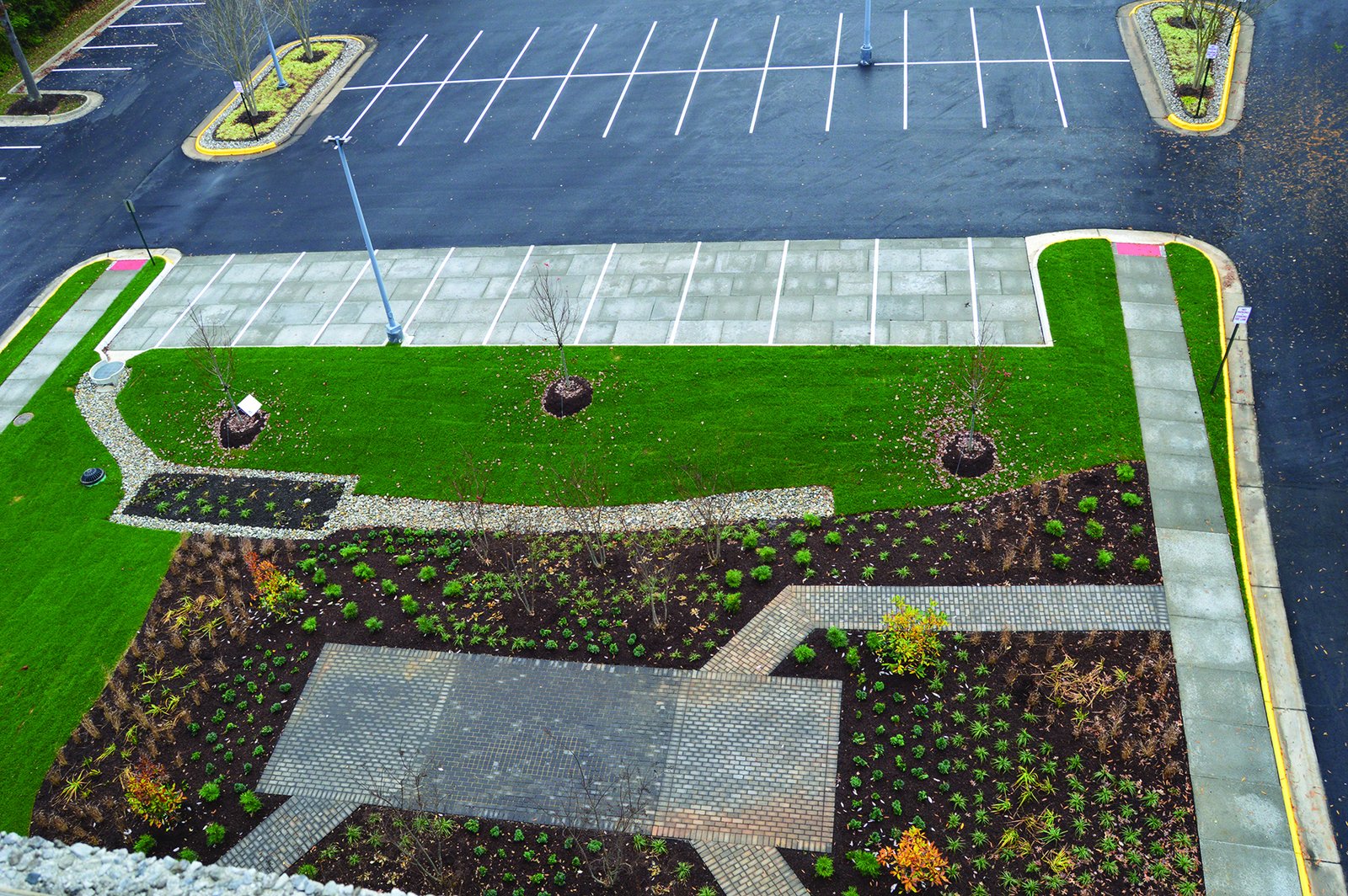
Shift change tests a parking lot harder than any ribbon cutting does. Two hundred cars arrive inside twenty minutes, a fuel truck waits at the gate, and a delivery driver tries to find the receiving door through all of it. A lot that was designed only as stalls and drive aisles starts to fail in exactly that moment, and it keeps failing because the base under it was built for cars and is now seeing trucks.
We build stabilized parking for industrial owners with the full traffic mix in mind: employees, visitors, contractors, service vans and the occasional loaded truck that takes the wrong turn. The word stabilized matters. In New Mexico the native ground ranges from clean sand in the river valleys to silty clay and cemented caliche on the mesas, and each one needs a different treatment before pavement goes down. Stabilizing the subgrade first, with compaction, imported structural fill, lime or cement treatment where the soils report supports it, is what keeps a lot flat after the first monsoon.
The owner experience we plan for is plain. The lot opens on the date promised, drains without ponding at the doors, and does not need patching in the first year.
Why parking is a bigger scope in New Mexico than owners expect
Industrial sites here are spread out, and workers drive. Few plants have transit at the gate, so parking counts are high and lots are large. Growth in the north puts a number on it: at a March 2025 NAIOP roundtable, Rio Rancho's mayor said the city had seen $6 billion in investment over ten years, with the Unser Gateway area drawing new commercial pads, and every one of those pads arrives with its own parking field to build and drain.
Public owners show the same pattern. Santa Fe Regional Airport completed a terminal expansion and new parking lots between 2022 and 2024, a reminder that parking is infrastructure and gets built to a schedule. In Rio Rancho, where manufacturing and pad development share the same road network, we coordinate lot construction with utility work and with the access drives that connect to state highways, so the lot is not stranded behind an unfinished driveway.
How we build the section under the stripes
We start with the geotechnical report and the traffic mix, then choose the section. A lot that sees only passenger vehicles can take a thinner asphalt over aggregate base. A lot that shares a drive with trailer traffic should get a thicker base and either heavy-duty asphalt or concrete at the turns and the entrances, where the wheel loads are highest and asphalt tends to rut.
In the field the order never changes. We strip, proof-roll, correct soft spots, place and compact the base in lifts with density tests, fine-grade to the drainage design, then pave. Curbs, wheel stops and island edges are set before paving so the pavement is not cut open afterward. Striping and signage go in last, with the accessible stalls laid out according to the plan we coordinate under site concrete and ADA compliance.
What changes the cost of a stabilized lot
Pavement type is the first driver, followed by the depth of the base and any treatment of the subgrade. A lot over soft silt that needs lime or cement treatment costs more per square foot than one over clean granular fill, but it tends to cost less over its life. Drainage structures, such as inlets, swales and a connection to the permanent detention, come next, followed by lighting, curbing and landscaping islands.
Heat matters as well. The Tucumcari record high was 111 degrees F on June 11, 2022, and any asphalt mix we specify has to hold a shape in that kind of sun without pushing under turning trucks. We show owners the price of the standard section, the price of a heavier one at the truck-facing areas, and what that heavier section avoids in repairs, so the decision is made with numbers.
Keeping people and equipment apart while a lot is built
On an active plant the lot is often built while the previous one is still in daily use. We phase the work so that one portion of the parking stays open, with temporary barricades, a marked walking route and a written traffic plan briefed to the owner's security staff. Paving equipment and rollers never cross a pedestrian route without a flagger.
Employees in a half-built lot are the main risk we plan around. We sign the route, light it where work extends past sunrise or sunset, and keep material deliveries on a separate lane from the cars. Hot work and asphalt trucks are scheduled to avoid peak arrival and release times, which usually means night or weekend paving on a facility with continuous shifts.
Site details that decide the design
Winter does more damage than people assume in the higher parts of the state. Water that gets into joints and cracks freezes, expands and breaks the surface, so we seal joints, keep birdbaths out of the grading and place inlets where water actually collects. Snow storage has to be planned too, since a plow needs somewhere to push it that is not a drainage swale or an accessible stall.
Lighting and conduit go in before the base, which is why we plan this scope together with yard lighting and electrical site work. Pole bases, conduit sleeves and handholes under future pavement are far cheaper to set now than to core later. The same discipline applies to sleeves for security cameras and gate operators.
Neighboring work and the buildings it serves
Parking seldom stands alone. On a warehouse it is paired with the trailer positions that make up truck courts and trailer yards, and the two have to be graded as one surface even if they are paved with different sections. On a distribution center the employee lot is separated from the truck court by a fence line and a controlled gate.
We also build lots for advanced manufacturing plants, which tend to have larger employee counts and tighter visitor-control rules than other industrial users, and for logistics and distribution owners, whose lots must flex between shift peaks and seasonal surges.
Send us the site plan and the shift counts
Give us the stall count, the truck mix and the soils report if you have one. We will return a section, a phasing plan that keeps your shifts moving, and a price with the alternates shown.
Common Questions
Is asphalt or concrete better for an industrial parking lot?
It depends on the traffic. Asphalt is the common choice for employee parking because it costs less per square foot and is easy to repair. Concrete is worth the extra cost where trailers turn and park, at dumpster pads and at entrance aprons. Many of our lots combine the two, with concrete at the heavy spots and asphalt for the rest.
Do we need to stabilize the soil if the lot only carries cars?
Usually some correction is still needed. Soft pockets, expansive clay and cemented caliche that was not fully excavated all show up later as dips and cracks. A proof-roll before base placement reveals them, and fixing them at that point costs far less than repairing the pavement. Whether lime or cement treatment is justified depends on the geotechnical report.
How long can parking be out of service during construction?
Seldom more than a few days at a time if we phase correctly. We close the area, reconstruct it in sections and keep the other sections open, with a written plan and barricades. Night paving is common for plants with continuous shifts. We confirm closures with the owner's security group before each phase.
Who handles accessible stalls and routes?
We lay them out as part of the concrete package so the slopes, curb ramps and signage match the approved plans. The slopes are checked with a level before the concrete is poured and again before it is accepted. Corrections are made while the forms are still in place, not after.
What about snow and ice in higher-elevation sites?
We plan for it in the grading. Slopes carry meltwater away from stalls and doors, inlets are placed where it collects, and a snow storage area is shown on the plan. Joints are sealed so meltwater does not freeze in the pavement.
Related
Related Services
Related Building Types
Related Industries
Related Service Areas
Ready to talk about your project?
Request a Project ReviewOne project team for the whole sequence
Industrial Contractors of New Mexico reviews the site, the loads, the schedule and the approvals before pricing, then schedules, coordinates and inspects the specialty trade partners from preconstruction through closeout.