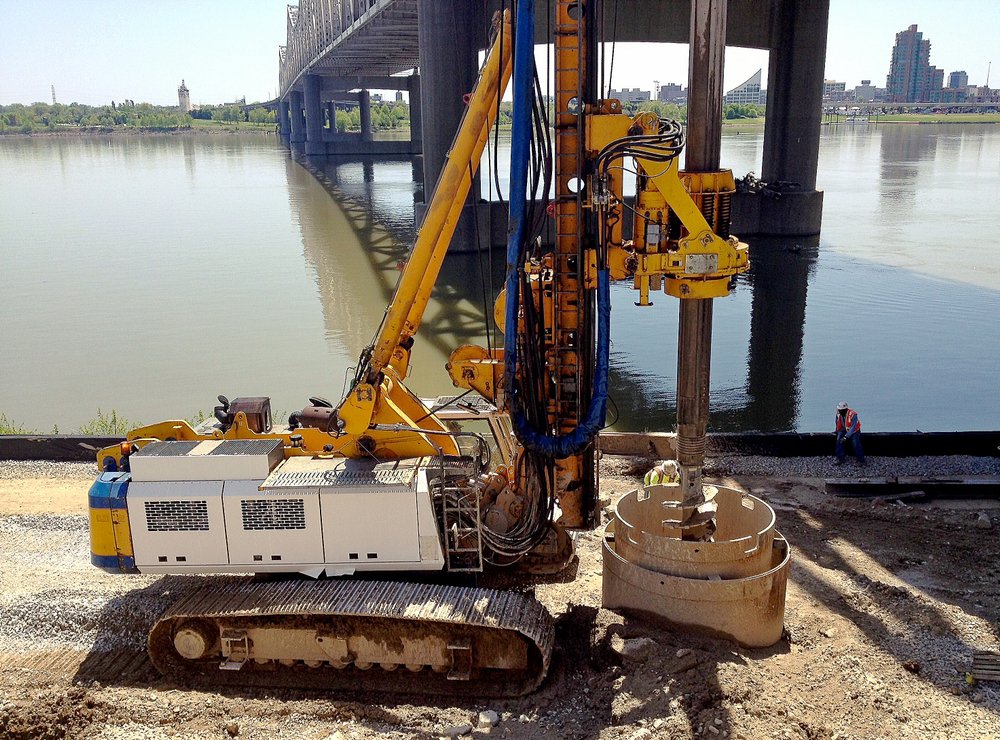
Most foundation problems in New Mexico begin with water, not load. A dry arroyo bed fills in twenty minutes, a flat valley floor holds a sheet of runoff for a day, a leaking utility line wets clay that has been dry for years, and the ground under a footing moves. Deep foundations exist to carry load past the soil that moves, down to material that does not, and to keep a building steady while the surface changes.
We build deep foundations for industrial structures that put heavy or sensitive loads on difficult ground: tall buildings with crane runways, process equipment, tanks, and structures near rivers and washes. The systems we use include driven steel piles, helical piles, micropiles and drilled shafts, and we choose them from the geotechnical report and the owner's schedule. Drilled shafts are covered in detail under drilled pier foundations; this page deals with how the choice between systems is made.
From the owner's side the path is the same each time: review the soils report, select the system, mobilize, install and test, then hand a pile or pier record to the structural engineer before the pile caps are formed.
Ground conditions across the state
The ground is not uniform. The Albuquerque Basin is part of the Rio Grande rift, with elevations within the city ranging from about 4,900 feet near the river to more than 6,700 feet in the foothills, and soils vary just as much. Alamogordo sits at the eastern edge of the Tularosa Basin, which is endorheic, meaning water collects and does not drain to the sea. In Deming, minor flooding sometimes occurs over large areas of flat ground, so a building site there may sit in a shallow sheet of water after a storm.
Silver City records a heavier example: on July 21, 1895 a wall of water rushed through the downtown business district and cut a ditch about 55 feet below the original street level. Those events explain why we ask owners where the water goes before we ask how deep the piles go. Industrial sites around Alamogordo and in the Rio Grande valley both require attention to the water table and the scour depth.
How we choose between piles, piers and spread footings
Spread footings are the cheapest option when the near-surface soil is firm and uniform. They stop working when the soil is soft, expansive, collapsible, or underlain by variable layers, or when the loads are too high for a footing of reasonable size. Driven piles suit sand and gravel layers with a firm layer below, helical piles suit lighter loads and tight access, and drilled shafts suit heavy loads and caliche or rock layers that driven piles struggle to penetrate.
We also consider noise and vibration. An advanced manufacturing plant with sensitive equipment beside the new foundation may not tolerate impact driving, which pushes the choice toward drilled shafts or helical piles. Access matters as well: some sites cannot take a large pile rig on the day it is needed, so we plan the rig route and a stable working platform before mobilization.
What we supervise and what we coordinate
We lay out the foundation, prepare the working platform, excavate and form pile caps and grade beams, place reinforcement and concrete, and survey the finished foundation. Specialty drilling and driving are done by qualified foundation subcontractors, and we manage them as part of our own schedule. That arrangement means one contact for the owner and one record at the end.
Testing is part of the work. Piles may be load-tested, and we coordinate with the testing agency, witness the readings and record them. When a test shows lower capacity than expected, the engineer of record decides whether to lengthen the piles, add piles or change the cap design, and we price those options quickly. Machine bases follow the same logic as our equipment pads and foundations.
Rigs, utilities and open holes
Foundation rigs are tall and heavy, and the work area has to be kept clear of people. We stake the rig route, barricade open holes at the end of each shift, and keep a spotter on any move near a line or a building. Underground utilities are located before drilling, and potholing is used for lines near a pile location.
Slurry, spoils and drilling fluids are managed so they do not run into drainage paths or onto owner property. On operating plants, the drilling area is isolated by barricades and a permit to work, and vibration is monitored when the owner's equipment is nearby. We stop when a reading passes the agreed limit.
What drives the cost of deep foundations
Depth, count, diameter and capacity are the main variables, followed by access and the cost of mobilizing a rig. A small job pays a large mobilization share per pile, so grouping foundation work with other site work sometimes lowers the cost. Difficult drilling, such as hard caliche, rock or caving sand, raises the price per foot, as does dewatering or casing.
The cheapest foundation on the drawing is not always the cheapest in the ground. A shallow system that settles can cost far more in repairs, and a deep system that is longer than necessary wastes money. We tell the owner what the soils report supports, show the alternates and flag the allowances that will be settled after the first piles are installed. Where the choice affects a warehouse floor or crane-ready bay, we explain the settlement tolerance in plain terms.
Put the soils report on the table first
Send us the geotechnical report and the loads. We will recommend foundation systems, show the cost range for each and give you a mobilization plan for the site.
Common Questions
How do I know whether my site needs deep foundations?
The geotechnical report tells you. It lists soil layers, bearing capacities, groundwater and any expansive or collapsible zones. If shallow footings would be oversized, settle too much, or sit above soil that moves with moisture, deep foundations are likely. We review the report with the owner and engineer before the choice is made.
What is the difference between piles and drilled piers?
Piles are driven or screwed into the ground, while drilled piers are formed by drilling a hole and filling it with reinforced concrete. Drilled piers work well in caliche, rock and dense layers, and they make little noise. Piles can be faster in sand and gravel. The soils decide which is better.
Will pile driving shake my existing plant?
It can, which is why we assess it first. If the owner has vibration-sensitive equipment, we choose a quieter system, such as drilled shafts or helical piles, and monitor vibration during the work. We set a limit with the owner and stop when it is reached.
How long does a foundation package take?
That depends on the count and depth. A small package can be mobilized and installed in days. A large one, with testing, caps and grade beams, runs for weeks. The sequence starts with permits and long-lead materials, and we share a schedule once the soils and loads are known.
What if drilling finds something unexpected?
We stop and notify the engineer of record. Typical findings include harder caliche, groundwater or voids. The engineer decides whether to change the depth, use casing or revise the layout, and we price the options before proceeding.
Related
Related Services
Related Building Types
Related Service Areas
Ready to talk about your project?
Request a Project ReviewOne project team for the whole sequence
Industrial Contractors of New Mexico reviews the site, the loads, the schedule and the approvals before pricing, then schedules, coordinates and inspects the specialty trade partners from preconstruction through closeout.