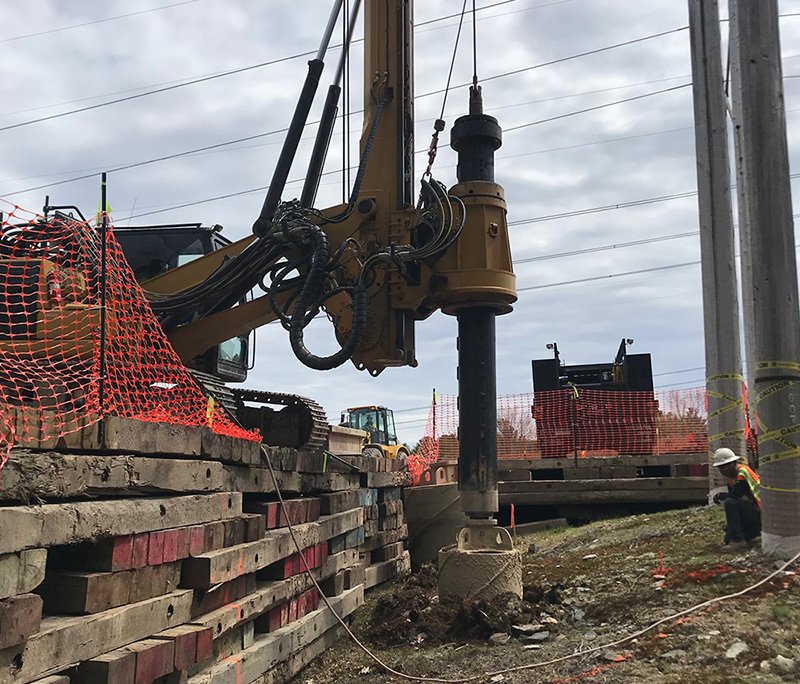
Each drilled pier is a small project with its own inspection, its own concrete ticket and its own record. The hole is drilled to a design depth, cleaned, checked, filled with a reinforcing cage and poured, and then it disappears under a pile cap. Nobody sees it again, so the quality has to be documented while the work is open, and the documentation has to be good enough for an engineer to rely on years from now.
We install drilled pier foundations, also called drilled shafts, for industrial buildings, equipment, light poles, tank and silo bases, and crane-supported structures across New Mexico. The method suits the state's ground: caliche and cemented layers that stop a driven pile, dry soils that stay open long enough to be drilled without slurry, and expansive clays where a pier carried below the active zone resists heave.
The owner's experience follows the steps of the work: layout and utility locates, rig mobilization, drilling, inspection of each hole, cage placement and concrete placement, then recording and demobilization. We provide a daily log for every pier that lists depth, diameter, soil observations, cage mark and concrete volume.
Engineering, special inspection and records
The foundation is designed by the engineer of record under the 2021 New Mexico Commercial Building Code (14.7.2 NMAC), issued under the Construction Industries Division, which adopts the 2021 International Building Code as amended and took effect July 14, 2023. The code requires special inspection of deep foundations, and we plan the work around the inspector's presence: no pier is poured until the inspector has seen the open hole.
The records are the deliverable. Each pier has its own sheet showing location against the survey, top and bottom elevation, observed soil, water or caving, cage identification, concrete ticket numbers and slump. If a pier is off location, short on depth or contaminated at the base, the engineer of record is notified before the cage goes in. The corrective action is decided in the field and written down.
Drilling, cleaning, caging and pouring
We start with survey control and a utility locate, then set a working pad for the rig. Drilling uses a rotary auger, with a rock auger or core barrel when the hole meets caliche or cemented layers. Where the hole will not stand open, we install a temporary casing, or use a slurry method if groundwater is present.
After drilling, the bottom is cleaned and the inspector checks depth, diameter and base conditions. The reinforcing cage is lowered in with spacers so it is centered, and the anchor bolt cage or dowels are set with a template. Concrete is placed from the bottom through a tremie or a drop chute, depending on groundwater, in one continuous pour. Top elevations are surveyed and the spoil is hauled to a designated area.
What we supervise and what we coordinate
We lay out, excavate for the pad, build the formwork for caps and grade beams, place reinforcement and concrete, and survey the finished foundation. Specialty rigs are provided by qualified drilling subcontractors, and we manage them alongside the other trades. The superintendent walks every hole with the inspector and signs the log with them.
The same crew often continues to the structure. A foundation for a structural steel frame is only useful if the anchor bolts land within tolerance, so a surveyor checks the bolt groups before the first column arrives. On a project with many piers, we create a pier map and a status board so the owner can see how many are drilled, poured and capped.
Production rates, weather and the critical path
A drilling rig can produce a limited number of piers per day, and the number depends on depth and the soil. We plan the sequence to keep the rig working, with the cage and concrete deliveries timed to the drilling. Where groundwater or casing slows the work, we add a second rig or extend the schedule, and tell the owner before the delay is felt.
Scale changes the plan. The Meta data center campus at Los Lunas reached over 4 million square feet with seven operating buildings and three under development by July 2025, and a July 2025 report said it employed more than 1,000 construction workers at peak. A campus like that sets up a foundation sequence with several fronts at once, with rigs, cage yards and concrete plants kept busy. Our smaller jobs follow the same discipline at a smaller scale, with Los Lunas as a reminder of what a repeatable process can do.
Structures that rely on drilled piers
The building types are varied: a tilt-wall building with heavy panels, a crane-served bay such as those in high-bay crane-ready buildings, a process structure on difficult soils, or a tank that cannot move. Piers are also used for pole bases, sign foundations and retaining walls at the site perimeter.
Intel opened Fab 9 in Rio Rancho on January 24, 2024 as part of a $3.5 billion advanced packaging investment that supported over 3,000 construction jobs. Work of that size shows how much foundation work a single industrial site can require. For data center owners and other large-footprint users, we compare drilled piers with other foundation systems in a deep foundation review before the system is chosen.
Review the pier layout with us
Send us the foundation plan and the soils report. We will check the pier count, depth and access, and give you a production plan and a price with the inspection and records included.
Common Questions
How deep do drilled piers go in New Mexico?
That depends on the soil and the load, and the engineer of record sets the depth. Some piers need only reach a competent layer a few feet down. Others pass through expansive clay or fill and extend much farther to resist heave or carry heavy loads. The geotechnical report gives the basis.
What happens if we hit caliche or rock?
We change the tooling. A rock auger or core barrel drills through cemented layers. If the layer is harder than expected, we notify the engineer and agree on the response, whether that is more drilling time, a different depth or a different foundation system. The cost of that change is discussed before the work proceeds.
Is a special inspector required?
Yes, deep foundations call for special inspection. The inspector observes drilling, checks depth and the bottom of the hole, and watches the cage and concrete placement. We schedule the inspector for each day of drilling and do not pour a pier before the inspection.
Can piers be drilled next to existing structures?
Usually, with care. We locate utilities, check the distance to the structure, and choose a method that limits vibration and loss of ground. If there is a risk, we monitor movement and agree on a limit with the engineer.
Related
Related Services
Related Building Types
Related Service Areas
Ready to talk about your project?
Request a Project ReviewOne project team for the whole sequence
Industrial Contractors of New Mexico reviews the site, the loads, the schedule and the approvals before pricing, then schedules, coordinates and inspects the specialty trade partners from preconstruction through closeout.