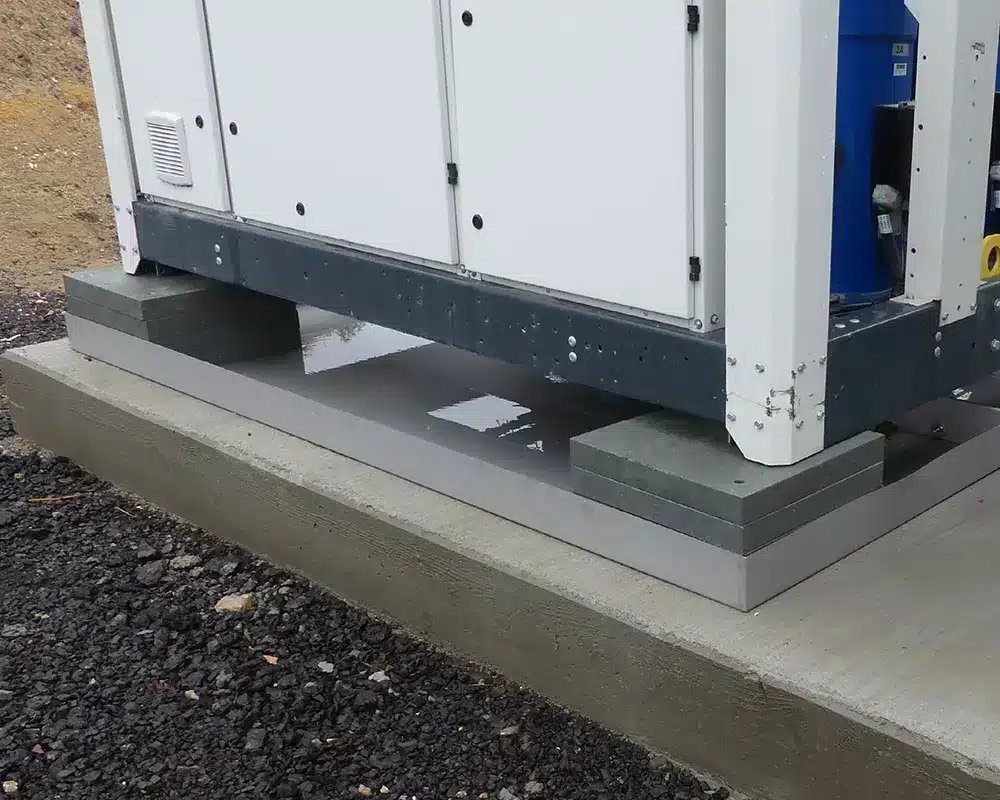
Rotating equipment finds a weak foundation within days of start-up. A compressor, a pump skid, a blower or a press that arrives with a vendor's loading drawing expects a pad that is level, stiff and isolated from the rest of the building. If the pad is a quarter inch out of plane, or the grout has voids, or the bolts sit a half inch from where the baseplate holes are, the equipment will tell you, loudly and at the worst time.
We build equipment pads and machine foundations from the vendor's drawings forward. The scope includes excavation and subgrade correction, formed and reinforced concrete, anchor bolt templates and sleeves, embedded plates, isolation joints, containment curbs and sumps, grouting and the final as-built survey. Pads range from a slab-on-grade for a skid to a massive block for reciprocating equipment, and the dividing line is set by the dynamic load, not by the size of the machine.
New Mexico owners tend to place this work in remote or constrained locations, so we also plan the logistics: where the concrete truck can reach, where the crane will set the equipment, and who locks out the adjacent line during the lift.
From vendor drawing to released pad
The first step is to gather the equipment data: weight, operating loads, frequency of vibration, bolt pattern and tolerances. We review it against the structural design and ask the vendor to confirm any open items before we place steel. Then we survey the pad location, mark the control lines and set benchmarks that stay in place until the equipment is set.
Anchor bolts are held in steel templates, set to the vendor's layout and checked with a survey before the pour and again after it. Reinforcement is placed with the cover and spacing the design requires. We pour with a pump or a chute depending on access, vibrate carefully around the embeds and cure the concrete according to the weather. Non-shrink grout is placed under the baseplate by a crew that has the vendor's procedure in hand, and the pad is released only after cube tests confirm strength.
Site and soil factors behind the design
The soil under the pad decides how deep and how wide it must be. The Albuquerque Basin is part of the Rio Grande rift, a valley bordered by faults that lifted the Sandia and Manzano Mountains, and soil conditions change across it. Sand, silty clay and cemented layers can all appear within a single plant site, so we rely on the geotechnical report and confirm what we find in the excavation.
Expansive soils can lift or tilt a lightly loaded pad, while soft or collapsible soils settle under a heavy one. Remedies include over-excavation and replacement with engineered fill, deeper footings, or piers carried below the active zone, covered in our work on deep foundations and piers. Isolation joints separate the machine block from the floor slab, so vibration does not travel into the building, and water must be drained away from the pad edges.
Permit path and special inspection
Foundations for equipment that is part of a building or structure fall under the 2021 New Mexico Commercial Building Code (14.7.2 NMAC), which adopts the 2021 International Building Code as amended and took effect July 14, 2023. The engineer of record specifies the concrete strength, reinforcement and testing, and the owner or the jurisdiction retains a special inspector to witness it. We schedule inspections ahead of each pour, since a missed inspection holds the entire sequence.
Equipment that holds fuel, oil or chemicals brings other rules, including secondary containment sized for the stored volume and sometimes an environmental permit. We detail the containment curb and sump as part of the pad so that the owner has one assembly to inspect. Anything that touches the pad, such as grounding, piping supports or conduit, is coordinated before the pour and not drilled into it afterward.
Setting pads against equipment delivery
The pad must be ready, cured and surveyed before the equipment arrives over heavy haul access roads, and it must not sit idle long enough to be damaged or have its bolts bent by construction traffic. We plan backward from the delivery and set a hold point for the vendor's field representative to inspect the pad. If the vendor finds a problem, we want to hear it while the formwork is still in the yard.
Refineries and mines have their own rhythms. The largest refinery in New Mexico operates in Artesia, and potash mines operate east of Carlsbad, in areas where outages are scheduled and work windows are short. Foundation work for a plant tie-in is usually done during a planned shutdown or beside an operating unit under a permit to work, with the pour planned to the hour and the concrete ordered with a back-up plant.
Work that surrounds the pad
Equipment pads are seldom ordered alone. The structural supports above them are built by the trade partners for structural steel erection, and the floor around them is part of industrial concrete floors.
Utilities and process owners such as power and utility operators and food and beverage plants use this service across the state, and the result goes into a manufacturing plant or a processing hall that depends on it. If you have a vendor drawing in hand, we can usually give a first price and sequence within a few days.
Send the vendor drawing and the soils report
Give us the equipment loading data, bolt layout and geotechnical report. We will return a foundation approach, a pour sequence and a schedule keyed to your delivery date.
Common Questions
When does a machine need its own isolated foundation?
When the equipment creates dynamic loads, such as reciprocating compressors, large fans and presses, or when its tolerances are tight. The block is separated from the floor slab by an isolation joint so vibration does not carry into the building. Light static equipment can often sit on a thickened slab. The vendor's data and the structural engineer decide.
How accurate must anchor bolt placement be?
Usually within a fraction of an inch, set by the vendor. We hold bolts in a steel template tied to survey control, check them before the pour and again after it, and record the readings. A bolt that has moved is corrected before the concrete sets, not by drilling the baseplate later.
What is grout for, and why does it matter?
Grout fills the gap between the baseplate and the concrete, so that load transfers evenly and the equipment does not rock. It must be non-shrink, mixed and placed according to the manufacturer's procedure, and cured without disturbance. Voids under a baseplate show up as vibration.
Can pads be built beside running equipment?
Yes, under a permit to work. We plan access, set barricades, and coordinate lifts and vibration with the operator. Where adjacent equipment is sensitive, we monitor vibration during excavation and compaction.
What if the soil turns out worse than the report said?
We stop and call the engineer. The usual responses are over-excavation and replacement with engineered fill, widening the footing, or switching to piers. Having the geotechnical engineer on call keeps the delay short.
Related
Related Services
Related Industries
Related Service Areas
Ready to talk about your project?
Request a Project ReviewOne project team for the whole sequence
Industrial Contractors of New Mexico reviews the site, the loads, the schedule and the approvals before pricing, then schedules, coordinates and inspects the specialty trade partners from preconstruction through closeout.