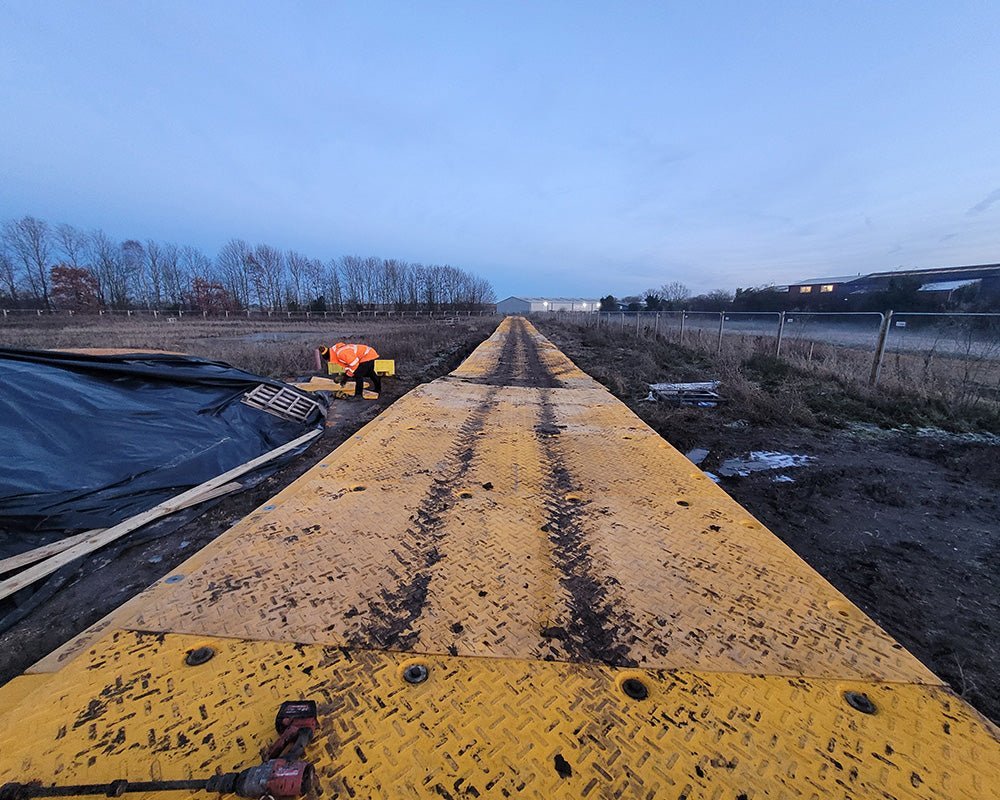
Every heavy-haul route starts with a number the county road was never built for: the axle load of the piece being delivered. A reactor vessel, a transformer, a rotor or a precast girder arrives on a multi-axle trailer that can weigh many times what the local farm-to-market road carries, and it needs a wider turn, a higher overhead clearance and a firmer shoulder than a normal truck. If the route is not built before the piece ships, the piece waits, and the crane and crew waiting for it cost far more per day than the road would have cost.
We build heavy-haul access roads as engineered sections, not as graded dirt. That includes the pavement or aggregate structure, the culverts and low-water crossings, the turning aprons, the shoulders and the connection to the public road. The work is common across the southeast and northwest corners of the state, where plants sit well off the highway and the last few miles decide whether a load arrives on schedule.
The gate-to-gate steps an owner will experience are simple to describe: a route survey, a load analysis, a written plan for crossings and utilities, a build sequence, a proof-load check and a handover with a maintenance plan for the haul campaign.
Where the route fails first
Failures cluster in four places: the crossings, the corners, the soft subgrade and the utilities overhead. An arroyo crossing that is dry for eleven months can carry a surge of water in the twelfth, so we design crossings either as culverts sized for the flow or as armored low-water sections that can take a flood and be regraded afterward. Corners are checked with a turning template of the actual trailer, because a trailer with a steered rear axle sweeps a different path from a tractor-trailer.
Subgrade is the next suspect. A cemented caliche layer provides a hard surface until the road crosses an area where the layer is thin or missing, and then it provides a sudden soft spot. We proof-roll the full alignment with a loaded truck and mark every deflection before we place the base. Overhead lines and pipelines that cross the route are located and either raised, protected or scheduled for temporary relocation through the utility owner.
What a heavy-haul road package covers
The package begins with survey and alignment, then clearing, grading and drainage. The road section is built to the load analysis: compacted subgrade, geogrid or geotextile where the soils require it, crushed aggregate base in compacted lifts, and a wearing course of asphalt, concrete or sealed aggregate depending on frequency of use. Turning aprons and the junction with the public road are usually reinforced concrete or thick asphalt.
We also install signs, delineators, gates, speed limits and a dust-control plan. In dry country, dust is a safety issue as well as a nuisance, because a convoy of heavy trucks moving through a cloud has limited sight distance. Water trucks, calcium chloride or a sealed surface solve it, depending on how long the campaign lasts and what the owner will accept on the property afterward.
Equipment and trades we schedule on the road
Heavy-haul roads need dozers, motor graders, compactors, water trucks and a surveyor with a rover who stays with the grading crew. We closely supervise the earthwork and base placement so the soft spot is reported to the same superintendent who decides how to fix it. That keeps the proof-roll findings out of a report and into the ground the same day.
Where the route follows a corridor under consideration for public improvement, we coordinate with the public owner before cutting. The Paseo del Volcan planning brochure hosted by the City of Albuquerque describes a roughly 30 mile four-lane freeway between I-40 and US 550 intended to open thousands of acres on the west side for manufacturing, distribution, data center and warehouse facilities. A private haul road in the Rio Rancho area can use public right-of-way plans as a guide for alignment and future connection.
Timing the road to the first oversized shipment
The road is on the critical path of the first heavy delivery, whether that is a turbine or the switchgear for a data center, so we schedule backward from that date. The usual sequence is route permit application for the carrier, utility coordination, clearing and grading, crossing construction, base placement, proof-load check, striping and signage. The state permit that allows the carrier to move an oversize load is separate from our work, but it depends on the route being passable, so we provide the as-built dimensions and load ratings the carrier needs.
In the Permian side of the state, around Carlsbad and Hobbs, horizontal wells in Lea and Eddy counties produced 29% of all Permian Basin crude oil in the first quarter of 2023, about 1.7 million barrels per day, according to the U.S. Energy Information Administration. That level of activity fills the roads with heavy trucks, so we plan haul-road work around the traffic of the area, with deliveries at the beginning and end of the day when possible, and with flaggers at every entrance.
Owners who need these roads
The owners who most often ask for them are utilities and power developers moving transformers and turbines, metals and heavy industry plants receiving fabricated assemblies, and data center builders bringing in generators and switchgear. When Urenco announced on 2 June 2026 that its Eunice expansion would support 300 to 600 U.S. jobs at peak construction, it signaled the amount of heavy equipment that such projects can put on a county road system.
The road is rarely the only scope. We tie it to stabilized laydown yards at the destination and to equipment pads and foundations where the load will be set. Owners in Carlsbad and the surrounding oil and potash country often bundle the three so one crew carries the route from the highway to the pad.
Tell us what has to arrive and when
Send us the heaviest piece, its trailer configuration and the target delivery date. We will walk the route, list the crossings and utilities, and give you a build plan with a proof-load check before the carrier moves.
Common Questions
How do we know the road is strong enough before the load moves?
We design the section from the trailer's axle loads and axle spacing, and we verify it in the field. Before the carrier moves, we proof-roll the finished road with a loaded water truck and inspect for deflection, rutting and soft spots. Any area that moves is dug out and rebuilt before the heavy load goes through.
Can you build the route across an arroyo?
Yes, with one of two designs. A culvert crossing is sized for the expected flow and covered with enough fill to carry the load. A low-water crossing is armored with aggregate or concrete so it can take a flood and be regraded. We choose based on how often the arroyo runs, how long the haul campaign lasts and what the permit authority allows.
What about the permit for the oversized load itself?
The carrier holds that permit with the state. We support it by giving the carrier the route dimensions, the turning radii, the load ratings of our crossings and the dates the road is available. Overhead lines and signs along the route are the carrier's responsibility to check, though we flag the ones we find during construction.
Do heavy-haul roads have to be paved?
Not always. A short campaign on well-compacted aggregate with dust control can serve for months. A road that will carry loads for years, or that connects to public traffic, is better paved at the aprons and the junction at least. We give the owner both prices with the expected maintenance for each.
How is dust handled in dry weather?
A water truck with a defined schedule is the usual answer, and calcium chloride or a sealed surface works for longer campaigns. Dust control is written into the haul plan, with speed limits for trucks, because reduced visibility is a safety hazard for everyone on the road.
Related
Related Services
Related Industries
Related Service Areas
Ready to talk about your project?
Request a Project ReviewOne project team for the whole sequence
Industrial Contractors of New Mexico reviews the site, the loads, the schedule and the approvals before pricing, then schedules, coordinates and inspects the specialty trade partners from preconstruction through closeout.