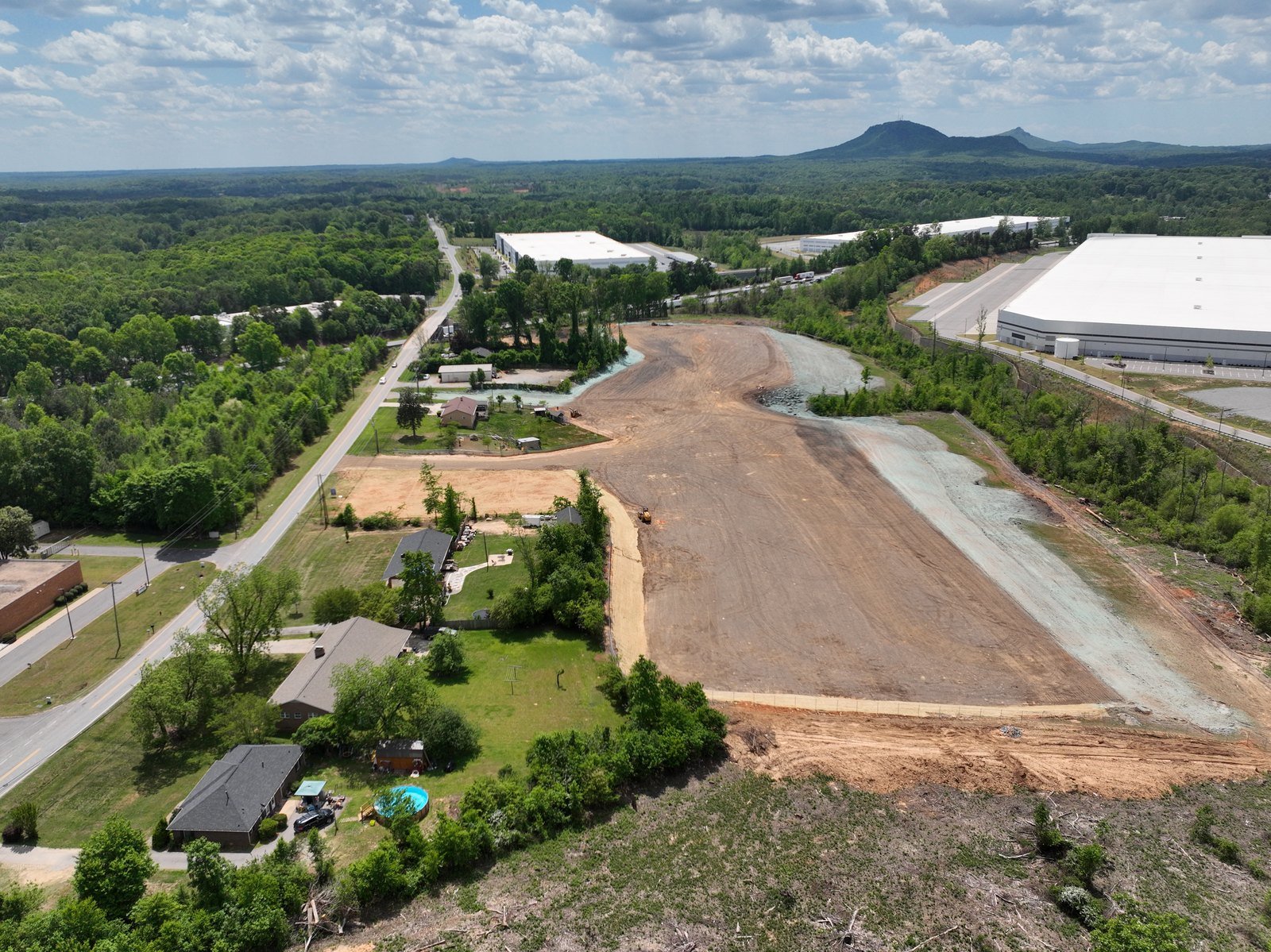
Material starts arriving before the building has a footprint, and the laydown yard decides whether that material can be received, counted and kept clean. On an industrial job in New Mexico the yard is rarely a flat corner of the parcel that happens to be graded. It is a working surface that carries delivery trucks, a rough-terrain crane, rebar bundles, precast pieces, pipe and the trailers of every trade, and it has to do that through a monsoon afternoon that can turn bare caliche and silty fill into ruts in an hour.
We build stabilized laydown yards as their own scope, ahead of vertical work, sized from the owner's delivery schedule instead of from whatever is cheapest to grade. A groundbreaking like the one Urenco held at Eunice on 18 August 2026, where the company said its investment at the site will rise to substantially more than $8 billion, shows how much staging ground large industrial work in southeast New Mexico can call for. The same logic holds on a small plant expansion with a fraction of the tonnage: the yard is sized to the material, not to the parcel.
On a live facility the yard also has to stay out of the way of operations. That means its own gate, its own haul route and a written permit to work for anything that crosses an owner's roadway. Owners usually see the yard as one line in the budget. In practice it sets the pace of everything that follows it.
What a stabilized yard includes from topsoil to gate
The work starts with stripping organic topsoil and removing soft spots found during a proof-roll with a loaded water truck. Where the native soil is clean and well graded we can often stabilize it in place. Where it is silty, or where a cemented caliche layer sits unevenly under the surface, we over-excavate, place geotextile if the geotechnical report calls for it, and build the section up with compacted structural fill and crushed aggregate base.
The finished surface is crowned or sloped to a designed low point, never left flat, because a flat yard holds water and a held puddle becomes a soft spot by the next delivery. Around it we cut perimeter swales, set a stabilized construction entrance with track-out control, hang the gates and mark the lanes. Crane pads, pipe racks and dunnage areas are laid out on the drawings before material arrives, so that a delivery driver is directed to a numbered spot and not to the closest open ground.
Grading permits, stormwater controls and arroyo drainage
A yard disturbs ground, and disturbed ground comes with paperwork. Most jurisdictions want a grading or site permit, and an area of disturbance above the usual threshold brings construction stormwater requirements with a written prevention plan, inspection logs and defined controls at the edge of the yard. We prepare and keep those records ourselves so the owner is not chasing them on a Friday afternoon before a delivery.
Drainage deserves its own review. A yard placed in the path of an arroyo, even a dry one, will see water on the day it matters least. We read the site grading for overland flow, keep the pad above the channel and route runoff to the detention or discharge point shown for the permanent site, which is why this work coordinates closely with stormwater detention and drainage and, where the parcel is raw, with site clearing and mass grading.
Sequencing the yard against deliveries and the permit to work
The yard has to be usable before the first long-lead item lands, so we plan backward from the delivery log. A typical sequence is survey and erosion control, strip and proof-roll, subgrade correction, base placement, fine grading, entrance and gates, then a walk-through with the owner's safety lead. Each step is signed off before the next begins, and the yard is not released for use until the walk-through is documented.
On sites near operating equipment, nothing moves through an owner's live area without a permit to work. We request it for the haul route, brief the drivers at the gate, and keep a flagger on any crossing. Out in the oilfield country around Hobbs, where EnergyPlex Park is described by the Economic Development Corporation of Lea County as the county's largest industrial park at over 9,600 acres, the distances are long and the drive-in time counts, so we stage fuel, water and a grading crew on site instead of calling them in for each pass.
What moves the price of a laydown yard
Four things drive cost. The first is thickness: a yard that will carry a crawler crane and loaded heavy haul trucks needs a deeper section than one that handles pickup trucks and pallets. The second is the quality of the native subgrade, since soft or expansive soil adds over-excavation and imported fill. The third is water, meaning the length of swales, the size of any temporary sediment basin and the controls needed at the property line. The fourth is how long the yard stays in service, because a yard that will be removed in six months does not need the same section as one that will be converted to a permanent truck court.
We price the section in layers and show the owner where a thinner base saves money and where it only shifts cost into repairs. When a yard can become permanent pavement later, we say so at the start, because building it to the final elevation can avoid tearing it up. That decision usually involves the same people who decide on truck courts and trailer yards.
Where the yard meets the rest of the site package
A laydown yard is rarely the only civil scope. It sits beside utility trenches, haul roads and, on process work, the foundations that the staged material is waiting for. Refinery, mine and enrichment-plant owners in Eunice and across the Permian side of the state tend to pair it with heavy haul access roads so that oversized loads reach the yard without crossing the plant.
Our project teams are familiar with the needs of metals and heavy industry owners, who stage large fabricated pieces, and with those of a new manufacturing plant where the same yard later becomes employee parking or an outdoor storage lot. Planning for that second life is cheaper than rebuilding.
Walk the site with us before material is ordered
Send the delivery schedule, the heaviest lift and the site plan. We will walk the parcel, mark where the yard should sit, and give you a written sequence for the gate, the haul route and the permit to work.
Common Questions
How big should a laydown yard be for a mid-size plant expansion?
Size it from the delivery log and the largest single lift, not from a rule of thumb per square foot. We list each major package, when it arrives, how long it sits and how much room the crane needs to swing and set it. The result is usually larger than owners expect for steel and precast and smaller than expected for equipment that goes straight to its pad. We show the footprint on the site plan so the owner can confirm it before grading starts.
Can the yard be reused as permanent paving?
Often yes, if it is built to the final grade and drains to the permanent system. The base section also has to match what the permanent pavement requires, since a light yard will not carry future trailer traffic. We raise the question at the start because the answer changes the thickness, the drainage and the edge details. If the yard is temporary, we plan for its removal and the restoration of the soil underneath.
What happens to the yard during monsoon season?
We design for it. The surface is sloped to shed water, the base is crushed aggregate and not native fines, and the swales and entrance controls are set before the rains arrive. After a heavy storm we inspect the yard, regrade any rutting and log the inspection before deliveries resume. On sensitive material, such as electrical gear, we also stage items on dunnage above the surface.
Do you need an owner permit to work for the haul route?
On any site with live equipment, yes. We submit the route, the dates and the equipment list, brief every driver at the gate, and put a flagger at each crossing of an owner roadway. The permit is closed out at the end of each day so nothing is left blocking an access lane.
Who handles the stormwater paperwork for the yard?
We do. We prepare the prevention plan, place and maintain the controls, keep the inspection logs and close out the permit when the disturbed area is stabilized. The owner receives copies of the logs with each pay application so the file is always current.
Related
Related Services
Related Building Types
Related Service Areas
Ready to talk about your project?
Request a Project ReviewOne project team for the whole sequence
Industrial Contractors of New Mexico reviews the site, the loads, the schedule and the approvals before pricing, then schedules, coordinates and inspects the specialty trade partners from preconstruction through closeout.