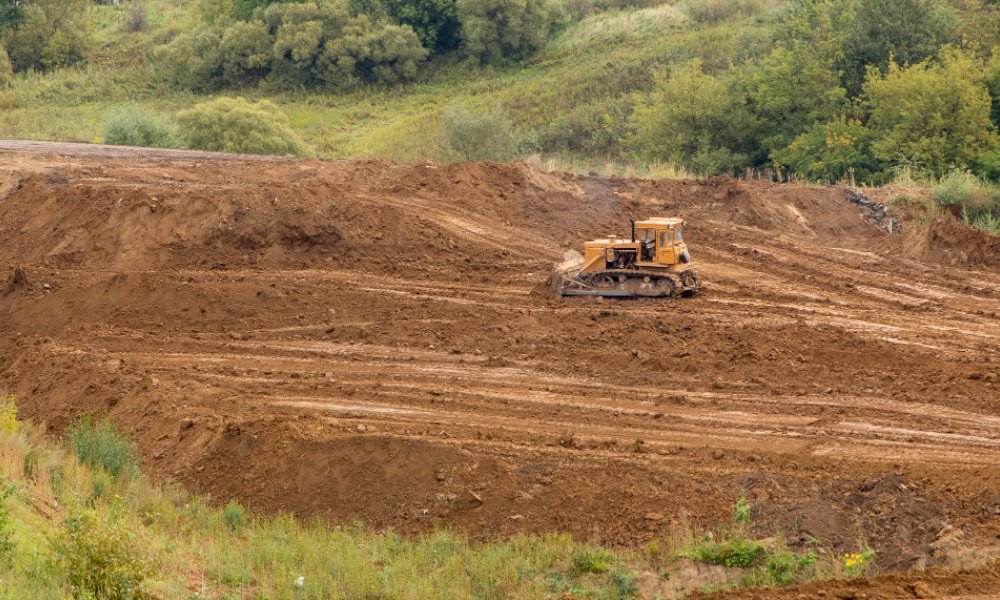
Caliche does not announce itself on the surface. A parcel in Lea County can look like flat scrub and still hold a cemented layer that turns a one-day ripping job into a week of hammering, while another parcel a few miles away is soft sand that needs stabilization before a truck can cross it. Clearing and mass grading is where those differences are discovered, and where the project's first real money is spent.
We treat earthwork as a controlled process, not a race. Before equipment arrives, we mark limits of disturbance, set erosion and sediment controls, locate and protect utilities and agree haul routes and gates with the owner. Grading then proceeds in lifts, with moisture control, compaction testing and survey checks, so the pad delivered to the foundation crew is the pad the engineer designed.
Our clients range from owners of a single warehouse pad to energy and industrial parks that need many acres prepared in stages. The work looks the same in a sketch but not in the field, which is why we keep the same crew leaders, the same safety routine and the same quality log across sizes.
The grading sequence from clearing to finished pad
The first step is clearing and stripping: removing vegetation, topsoil and debris, stockpiling usable topsoil and hauling off the rest. We then cut and fill to subgrade, working from the geotechnical recommendations on over-excavation, moisture conditioning and structural fill. Each lift is compacted and tested before the next is placed, and results are logged by location and elevation.
Throughout, we manage water. Temporary swales, berms and sediment basins direct runoff to controlled points, and we adjust them as the grade changes. When the pad reaches subgrade, we survey it and hand it over with a record of tests, so the foundation contractor and engineer can verify it. The trade team for stormwater detention and drainage then builds the permanent facilities into the finished grade.
Ground and water conditions to expect
Soils vary sharply across the state, from the high plains around Hobbs to the river terraces of the south. The Albuquerque Basin, the Estancia Valley, the Tularosa Basin and the Pecos River valley each present different bearing, moisture and drainage problems. Alamogordo sits on the eastern edge of the Tularosa Basin, which is endorheic, so surface water has nowhere to go but low ground. Deming's city profile notes that minor flooding sometimes occurs over large areas of flat ground, which means a graded pad in Deming needs a drainage path from day one.
Dust and wind are real constraints. Plant managers are often surprised by how far fines travel from a disturbed site. Dry spring winds can carry fines from a disturbed site, and we plan water trucks, stabilized haul roads and temporary cover to keep dust under control. In summer, monsoon storms can wash out an unfinished pad in a single afternoon. We watch the forecast, stabilize slopes and protect trench lines before storms, and we document the condition of controls after each event.
What the earthwork package covers
The package includes clearing, stripping, rough and fine grading, cut and fill, structural fill placement, subgrade preparation for building and pavement, haul roads, laydown yard preparation, and temporary erosion and sediment controls. Where rock or heavy caliche is expected, we include ripping, hammering or blasting by licensed specialists, depending on what the borings show.
We also coordinate surveying, materials testing and the geotechnical engineer's field observation. For larger sites, we prepare a grading phasing plan that opens work areas in sequence, so that disturbed areas are limited at any time. Access roads for construction are built to the standard we describe in our heavy haul access road work, which keeps delivery trucks on the job in wet weather.
What drives earthwork cost
Quantity and haul distance dominate. Balanced sites, where cut equals fill, are cheapest; sites that need imported fill or export of surplus are not. Material type matters too: rippable caliche costs less than rock, and soft soils may need over-excavation and replacement. We run quantity takeoffs from survey data and show cut, fill, import and export separately.
Scale changes the economics. EnergyPlex Park near Hobbs is described by the Economic Development Corporation of Lea County as the county's largest industrial park, with over 9,600 acres, and a proposed 1,350 acre solar farm at the Lovington industrial park shows the acreage energy projects can cover. We scale equipment and crew to the size of the site, and we report production daily so owners can see progress against the plan. Industrial owners in utilities and power often ask us to prepare large pads and roads in phases.
Equipment, utilities and the people around them
Earthwork has high-consequence hazards: moving equipment, steep cuts, buried and overhead utilities, and rollover. Every operator is briefed on site rules, spotters are used around pedestrians and tight areas, and utility locates are verified before digging. We keep a clear separation of equipment and foot traffic, and we maintain trench and slope protection to the required standards.
For work near an operating distribution center or inside an industrial park, we coordinate gate times and truck routes so our hauling does not interfere with customer traffic. Our permit to work covers excavations, and the excavation permit is renewed daily. The result is quiet, controlled earthwork that does not make the news.
Get a grading plan with real quantities
Send the survey and the geotechnical report if you have them. We will return a cut and fill estimate, a drainage approach for the construction period and a mobilization sequence.
Common Questions
How do you handle caliche?
We read the borings first, then choose the method that fits: ripping when the layer is thin or fractured, hammering when it is thicker, and blasting only when needed and permitted. The estimate states the method and the assumed quantity of hard material so any difference is easy to explain.
Do you provide compaction testing?
Yes. An independent testing agency or the owner's geotechnical engineer tests each lift under our coordination. We keep the results with the survey so you receive a record of what was placed and where.
What does erosion control involve?
It begins with a plan that shows limits of disturbance, perimeter controls, inlet protection and stabilized entrances. We install, inspect and repair controls, especially after storms, and we document the inspections. Larger sites may need coverage under a construction stormwater permit, which we help prepare.
Can you start grading before the building permit is issued?
In many jurisdictions a separate grading permit allows this. We check what the local authority permits, describe the risk if the building design changes after grading, and let you decide. Starting early can save weeks, but it needs a stable layout.
How do you keep dust down?
With water trucks, stabilized haul roads, limited exposed area and schedule changes during high winds. We also keep trucks covered and clean tires at the gate so that dust and mud do not spread to public roads.
Related
Related Services
Related Building Types
Related Service Areas
Ready to talk about your project?
Request a Project ReviewOne project team for the whole sequence
Industrial Contractors of New Mexico reviews the site, the loads, the schedule and the approvals before pricing, then schedules, coordinates and inspects the specialty trade partners from preconstruction through closeout.