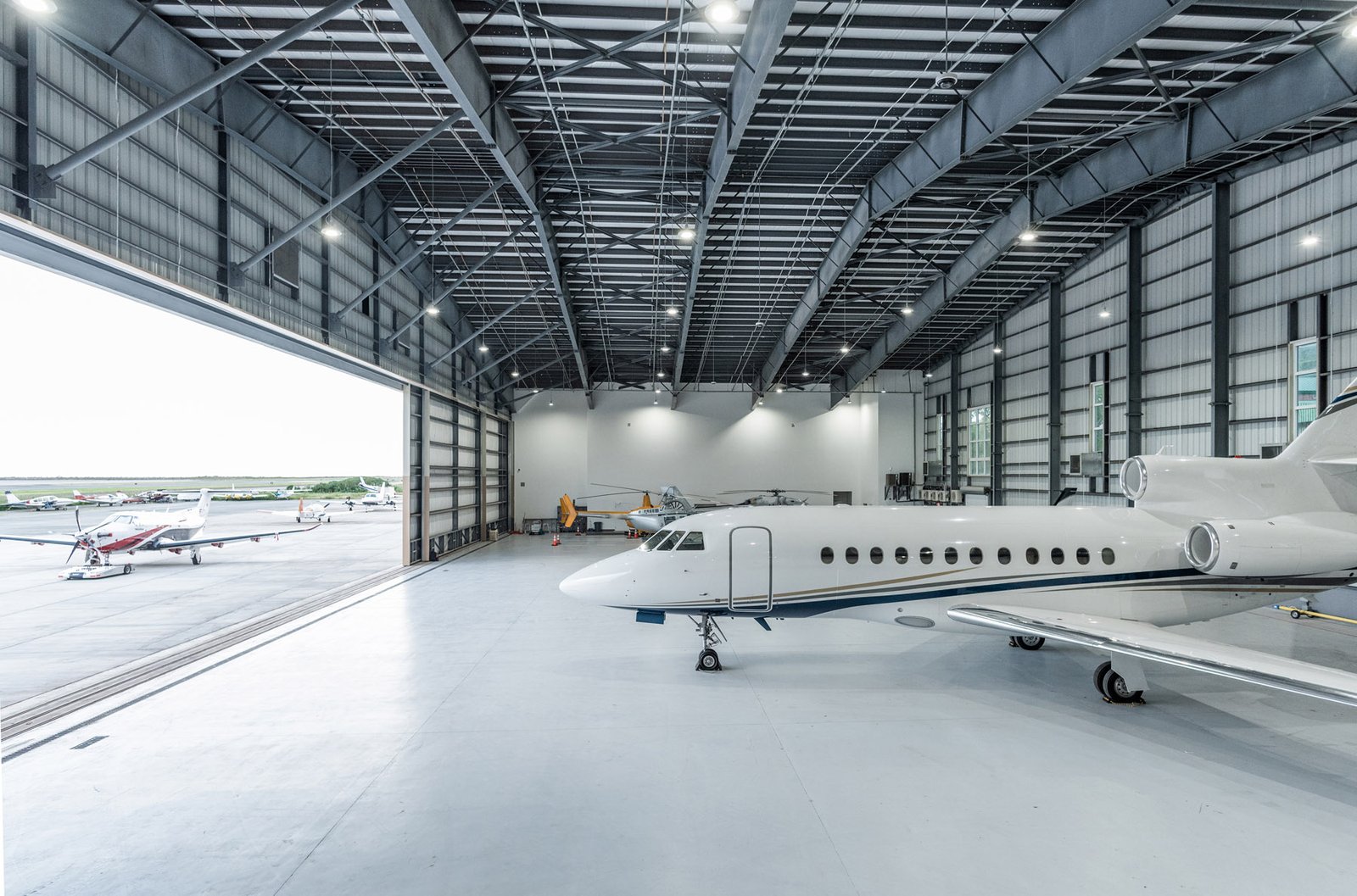
Roswell Air Center spreads across 5,029 acres five miles south of the city, with a 13,000-foot runway and a second runway of 10,008 feet. Tenants there include aircraft repair and refurbishing companies and a large aircraft storage site where over 300 aircraft were ferried in 2020. A field of that size is a reminder that hangars are working buildings: they cover aircraft, tools, people and fire risk under one roof, and they sit on land the airport owns. We build aircraft hangars in New Mexico with that in mind.
A hangar project begins with the aircraft. Wingspan, tail height, weight and the number of aircraft decide the clear span, the door opening and the floor design. After that come the lease, airport approvals and the access route through the security fence. We ask for the aircraft list, the intended use and the airport sponsor's requirements on the first day.
The owner's experience is a sequence of approvals and building steps: airport authorization, permit to work, site and apron, foundation, frame, door, envelope, fire suppression, utilities and acceptance inspections. Each step has a signature, and each signature has a name behind it.
Where hangar demand shows up
Airports across New Mexico serve different missions. In the south, a May 2022 report said the Santa Teresa airport would receive new hangars and a cargo-only runway, with private builders constructing speculative warehouses nearby, so Santa Teresa mixes air cargo, rail and border commerce. Spaceport America covers 18,000 acres in Sierra County, adjacent to White Sands Missile Range, with access to 6,000 square miles of restricted airspace.
In the middle of the state, Double Eagle II Airport on Albuquerque's West Mesa has about 125 based aircraft, 57,000 annual operations and a 7,398 foot runway with ILS. In Roswell, the National Championship Air Races are held at the air center beginning in 2025. Each airport has its own sponsor, its own rules and its own pace of approval, which is why we begin with the sponsor's lease and development standards. Projects for Spaceport America follow the Spaceport Authority's requirements.
Approvals on airport land
Hangars need two sets of approvals. The airport sponsor reviews the lease, the site plan, the building height and the effect on taxilanes, and federal airspace review may apply near runways. The state building permit follows the 2021 New Mexico Commercial Building Code, adopted from the 2021 International Building Code as amended. The energy envelope falls under the 2021 Commercial Energy Conservation Code.
Fire protection is the other review. Hangar fire protection depends on the size of the hangar, the aircraft stored and whether fueling or maintenance occurs inside. Foam, deluge or other systems may be required, and the fire protection engineer proposes the design for review. We prepare the permit set with the sponsor's letters, the engineer's calculations and the water supply information that the fire authority expects.
The structure, door and floor
The clear span is the defining feature. Spans of many tens of feet are achieved with rigid frames, trusses or long-span steel, using systems such as a pre-engineered metal building for smaller hangars or structural steel erection for larger ones. Where the maintenance bay needs hoists or cranes, high-bay crane-ready buildings use the same planning for runway beams and column loads.
The door is the largest moving part of the building. Bi-fold, hydraulic, sliding and rolling doors each have different cost, wind resistance and clearance. The header above the opening carries the roof load, so its design is part of the structure. The floor is a smooth, sealed slab with slope to drains, oil separation and tie-downs, and it must carry aircraft on wheels and jacks.
Site choices that decide the project
Orientation, apron size and taxilane clearance are set by the airport. The apron in front of the hangar must carry aircraft loads and drain away from the door. We design the paving for the heaviest aircraft expected, and we check that jet blast, prop wash and wing clearance do not conflict with neighbors. Utilities are brought across the airport's security line, so we schedule crossings and escorts in advance.
Airside work requires coordination with the airport operations office. Construction hours, haul routes, equipment heights and foreign object debris controls are agreed before mobilization. A crane or tall lift that is routine on a normal site may need a notice and a flag. Owners who also repair or refurbish aircraft may need a manufacturing plant style building with process utilities, and those in advanced manufacturing or aerospace support may want both.
Work we handle directly
We schedule and supervise the site, apron, foundations and concrete, and we manage the erection of steel and the door installation. These are the items that most affect the schedule and the quality of the hangar. Our field team understands the importance of dust control, debris control and clean access on an airport, and the superintendent keeps the work area tidy and secured.
Fire protection and utilities are coordinated with specialty subcontractors and the airport's utility owners. Our fire water loop and hydrant systems work supports hangar projects that need a dependable water supply and flow tests, which we schedule with the fire authority before the system is covered.
Lead times and flying weather
Doors, steel and fire suppression equipment are long-lead items, and the airport approval process may take longer than construction. We start the approval and the long-lead orders together and build the foundation while the steel is fabricated. Door installation is scheduled after the frame is complete and plumb.
Elevation and wind affect the calendar. Four Corners Regional Airport sits at 5,506 feet and the Albuquerque Sunport at 5,355 feet, where winter nights call for concrete protection, while low desert sites have hot-weather pours. We stop lifts and door work when wind exceeds safe limits, since a large door panel acts as a sail.
Start with the aircraft list
Tell us the aircraft, the airport and the use. We will answer with a span and door concept, the approvals in the path and a schedule.
Common Questions
Who approves construction on airport property?
The airport sponsor, usually a city, county or authority, approves the lease, site plan and building, and federal airspace review may apply. The state building permit is separate. We start both in parallel and keep a log of the approvals.
How wide should the hangar door be?
The door should clear the widest wingspan and the tallest tail with room for a tug and a crew to move the aircraft safely. We size it from the aircraft list plus planned growth. A wider door costs more and adds header depth, so we price two sizes if the fleet may change.
What fire protection does a hangar need?
It depends on size, use and the aircraft stored. Foam, deluge or other systems may be required for larger hangars or those with fueling and maintenance. A fire protection engineer designs the system, and the fire authority reviews it. We confirm the water supply early because it can limit the design.
Can a hangar be built for a few small aircraft?
Yes. Smaller hangars can use pre-engineered frames with sectional or bi-fold doors and a simple slab. Even a small hangar needs sponsor approval, a permit and utilities. We help owners assess whether one larger hangar or several smaller ones suits the lease.
Does the floor need to be special?
It should be smooth, durable and sloped to drains, with a sealer that resists fuel and hydraulic fluid. It also carries concentrated wheel and jack loads. We design the slab thickness and reinforcement for the heaviest aircraft and provide oil separation where required.
Related
Related Services
Related Building Types
Related Service Areas
Ready to talk about your project?
Request a Project ReviewOne project team for the whole sequence
Industrial Contractors of New Mexico reviews the site, the loads, the schedule and the approvals before pricing, then schedules, coordinates and inspects the specialty trade partners from preconstruction through closeout.