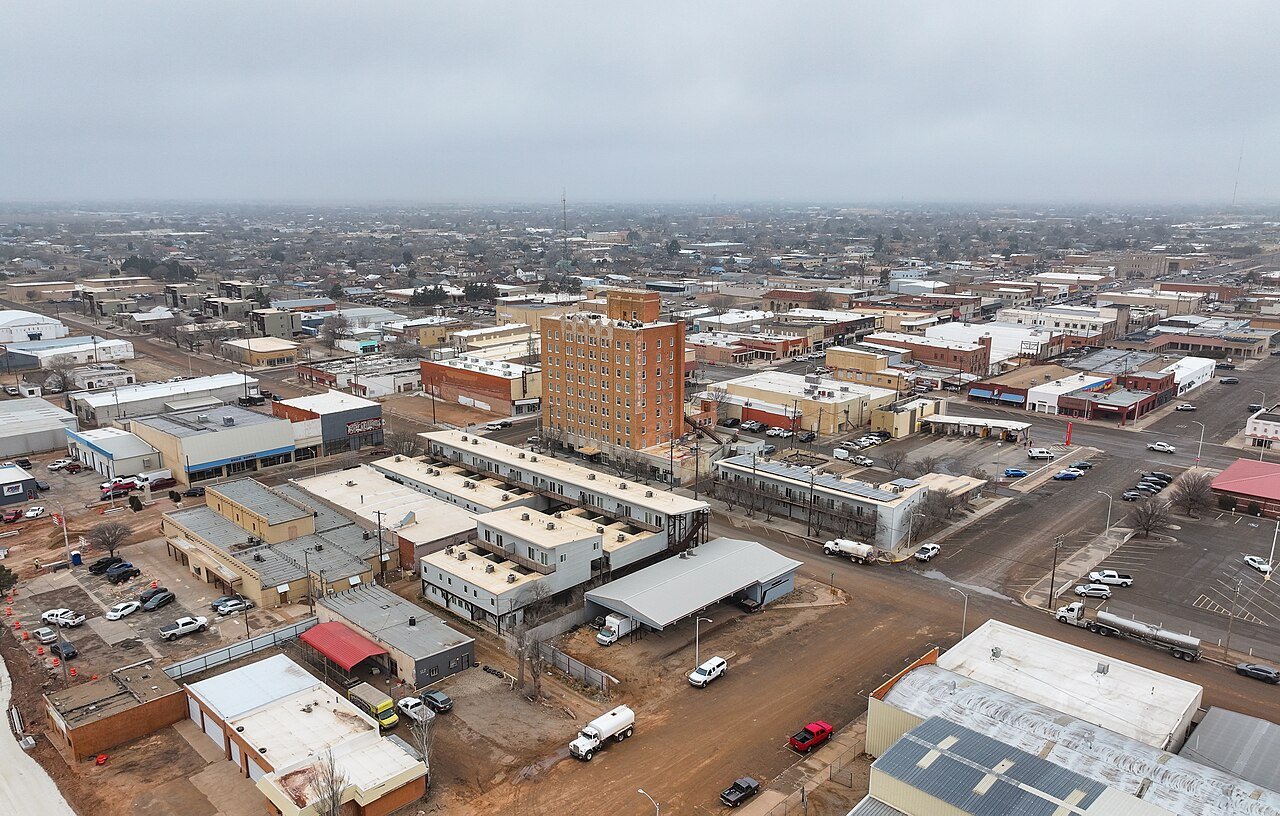
Rail-served industrial ground with power already at the property line saves an owner months, and Clovis has more of it than most eastern New Mexico towns. The Clovis Industrial Park is described by Clovis Economic Development as a shovel-ready, certified industrial site with on-site BNSF railway and Xcel Energy, and its industrial parks have 230 acres of land available for development. We build on that kind of ground: warehouse and cold-storage shells, spur-served yards, process buildings and the truck circulation that connects them.
BNSF operates a division point and a large freight classification yard on its Southern Transcon at Clovis, and more than 100 mostly intermodal freight trains arrive and leave daily. U.S. Routes 60, 70 and 84 pass through the city, with Routes 60 and 84 heading west to Fort Sumner and Route 70 running southwest to Portales. A building on this ground can receive freight by rail, move it on four-lane federal routes and ship it to the Texas panhandle or the Rio Grande corridor.
We approach a Clovis parcel the way a railroad operations manager approaches a train: where does it enter, where does it stop and how does it leave? The building comes after the answers.
Spur-served warehouses and process buildings
Warehouses for rail-served owners differ from highway-only warehouses in a few ways. They need door positions that match track spacing, covered or open unloading areas, floors that tolerate forklift traffic from rail cars, and yards sized for truck transfer. Our warehouse shell construction places the building so that rail and truck flows do not cross.
For processing owners, we provide shells with extra clear height, equipment bays and heavy slabs, plus trench drains and utility sleeves located before concrete is placed. Where refrigeration is part of the program, our cold storage construction adds insulated panels, vapor barriers and sub-slab heating to protect against frost heave.
Dairy processing, base work and trade
Clovis Economic Development lists Cannon AFB at 5.6K employees including active, contract and civilian staff, Eastern New Mexico University at 1.3K, Clovis Municipal Schools at 1.1K, a home care provider at 750 and a cheese plant at 440. A KFDA report in November 2025 said the base would receive over $80 million secured by Senator Martin Heinrich, including an $80 million 192-bed dormitory and over $8 million for a security forces training facility, with no date announced for the upgrades.
A cheese-industry expansion announced in November 2015 was described as a $140 million project that would raise operational capacity by 30 percent. It is an older announcement, so we use it as evidence that food processors invest here, not as a current pipeline. The common thread is a local economy tied to food, defense and freight, with steady demand for food and beverage and support buildings.
Wind, frost and a plains climate
Clovis sits at 4,266 feet and receives about 18.5 inches of rain and 10 inches of snow per year, according to the city's economic brochure. That climate is dry enough for most of the year to allow steady earthwork, but frost and spring wind need planning. Footings go below frost depth, slabs on grade over insulated areas need protection from freezing and exposed steel is braced for gusts during erection.
Open plains ground means long sight lines, so owners should think about screening, dust control and drainage that does not send water onto neighbors. We schedule detention basins and swales early so they are working before the first heavy rain, and we stabilize disturbed soil to keep the wind from taking it.
Where industrial-park savings show up
Certified sites reduce risk, but they do not remove costs. Owners should still budget for the rail connection or switch, the interior roads, the building pad and the utility service. A park with on-site rail and electric service shortens the utility run, which lowers cost and schedule risk compared with a bare parcel on the edge of town.
The biggest swing item for rail users is the track itself. Turnouts, ballast, ties and crossings are priced by the railroad's specification, and we ask for those details before a budget is set. For truck users, concrete thickness at the dock aprons and in the turn areas is the largest paving expense, and we offer options that balance first cost and maintenance.
Programs that span several sites
Some owners in the region operate more than one plant or distribution point. For them we coordinate programmatic multi-site rollouts with common standards, a shared procurement schedule and repeat crews. A Clovis building may be one of several in a regional network, and we match its specification to the others so the owner's maintenance teams do not have to relearn each site.
Neighboring Portales and the Texas-border communities of Hobbs and Lovington can be part of the same program, and we group mobilizations to save travel.
Gate-to-gate on an active rail and truck park
On an occupied park, we start by agreeing on routes for construction vehicles and the park's trucks, where the safety fence goes, who inspects excavations and how rail cars are protected. Work near tracks follows the railroad's rules, and we do not enter the right of way without the proper authorization.
At turnover, the owner receives as-built drawings, test reports, equipment manuals and a maintenance checklist. A facility manager can use these to plan inspections, joint sealing and pavement care, and it makes the next expansion easier to design.
Start with the track and the gate
Send us the parcel, the freight mix and the date you want product moving. We will return a layout, a rail and utility plan and a sequence you can hold us to. Look at cold storage options if your product is temperature-controlled.
Common Questions
Do I need rail service to benefit from a Clovis industrial park?
No, but rail is a differentiator for bulk, intermodal and heavy freight users. Highway access via the area's U.S. routes works for many tenants. We design the site so that a spur can be added later if the owner leaves room for it.
How long does it take to build a spur?
It depends on the railroad's review and material lead times. We start the coordination at the concept stage so that the track design is approved before the building's pad is graded.
What does frost depth mean for my foundation?
Footings must reach below the depth to which the ground freezes, so water in the soil cannot lift them. Local code and the geotechnical report set the depth, and cold-storage floors need added protection.
Are old expansion announcements a reliable market signal?
They show that investment has occurred, but they do not predict future demand. We use current owner programs and lease demand to size a building, not past headlines.
Can you build near an active rail line safely?
Yes, with the railroad's rules, flagging, set-back distances and daily briefings. Workers receive orientation, and the owner or railroad representative approves any work close to the track.
Related
Related Services
Related Industries
Related Service Areas
Ready to talk about your project?
Request a Project ReviewOne project team for the whole sequence
Industrial Contractors of New Mexico reviews the site, the loads, the schedule and the approvals before pricing, then schedules, coordinates and inspects the specialty trade partners from preconstruction through closeout.