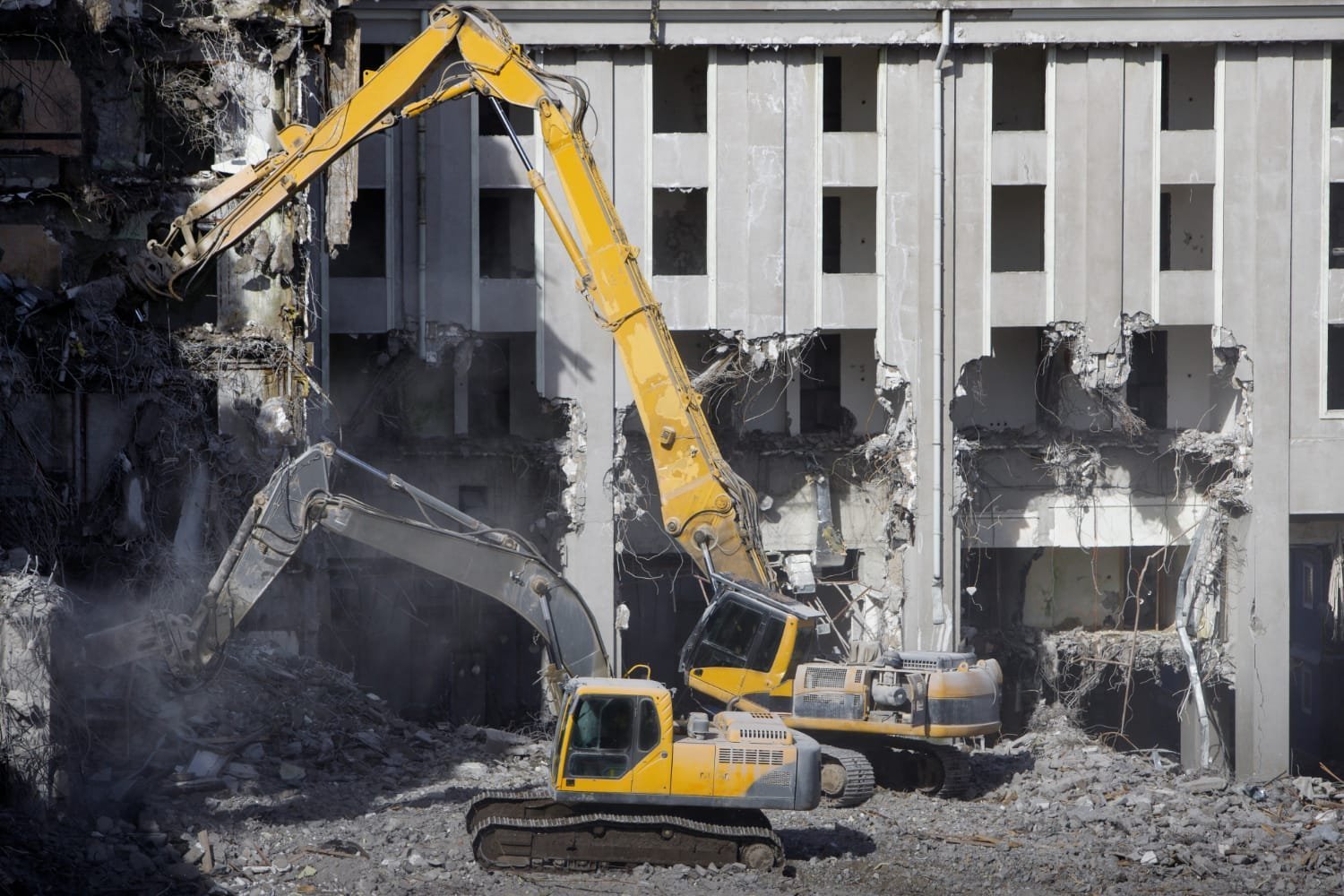
Before a plant comes down, someone has to prove it is empty. Product, fluids, residues, stored chemicals, live electrical feeds, buried lines and hazardous building materials are identified, isolated and removed before the first wall is pulled. Industrial demolition in New Mexico is as much survey and isolation as it is heavy machinery, and the sequence is the part owners remember.
We take down industrial buildings, process structures, tanks, equipment foundations and yards. The goal is usually one of three: clear a site for a new building, remove a failing structure while the plant keeps operating, or retire a facility and leave the ground in a condition the owner can sell or reuse. Each goal changes the level of salvage, the disposal route and the finished grade.
We describe the steps the owner will see from the gate: the survey, the permits, the disconnects, the abatement, the take-down, the sorting and recycling, and the final grading with its documentation.
License class, permits and notifications
New Mexico licenses contractors by classification. Under 14.6.6 NMAC (Construction Industries Licensing, Classifications and Scopes, effective March 10, 2022), the GB-98 General Building classification requires four years of foreman level experience, at least two of them commercial, and covers erecting, altering, repairing or demolishing residential and commercial buildings and certain structures. Owners should confirm that any demolition contractor holds the classification the work needs and ask to see it.
Permits come from the local building authority, and utility disconnects must be confirmed by the utility before work begins. In most cases an asbestos inspection is required before a building is demolished, and notification to the environmental agency may follow. Stormwater and dust rules apply to the site. We keep a permit and notification log so that the owner has a complete record when the job ends.
Plants that retire and buildings that are reused
Large industrial assets do reach the end of their service. Near Farmington, PNM said on September 30, 2022 that the last unit of its coal-fired San Juan Generating Station had been removed from service, following Units 2 and 3 in 2017 and Unit 1 in June 2022. Retirement of a facility of that kind raises questions of decommissioning, salvage and site reuse that smaller plants face in miniature.
Reuse is more common than total removal. In March 2020 a company bought the former 90,000 square foot cheese plant in Lovington and planned more than $15 million of investment and 125 direct jobs within five years, with state and city incentives. Converting a building like that begins with selective demolition inside: taking out old equipment, walls and slab sections so new process lines can be set.
What comes down and what leaves the site
Whole-structure work covers steel and masonry buildings, silos, tanks, stacks and concrete structures. Process equipment is disconnected, drained, cleaned and cut or lifted out, and piping is removed back to the isolation point. Foundations, pits, sumps and below-grade structures come out, with the voids backfilled and compacted in lifts. Where a new building follows, we leave the site graded to the design elevations.
Selective demolition inside a running or standing building removes walls, mezzanines, equipment and portions of slab while protecting the rest. Materials are sorted on site: steel is sold for scrap, concrete is crushed for base where permitted, and the remainder is hauled to approved disposal. We report quantities and keep receipts so that the owner can document recycling and disposal.
Isolation, permit to work and dust
The most important safety step is isolation. Electrical, gas, water, steam, compressed air and process lines are locked out and verified before the crew touches the structure, and tanks and vessels are tested for atmosphere before any cutting or entry. We apply confined space rules where they apply, use a permit to work for hot cutting, and keep a fire watch. A written demolition sequence addresses structural stability, so no partial wall or frame is left to fall unexpectedly.
Dust, noise and vibration are managed for the neighbors as well as the crew. Water spray, haul route control and sweeping keep dust on the site, and monitoring is used near sensitive equipment or occupied buildings. Exclusion zones are marked and enforced during every takedown, and visitors to the site check in with the foreman.
Sequence and what controls the calendar
The calendar is controlled by the front end more than by the machines. Surveys, abatement clearance, utility disconnects and permits come first, and each depends on a third party. We start them in parallel, track them on one list and tell the owner which one is holding the date. Once clearance is in hand, the take-down of a typical industrial building goes quickly, and the sorting, hauling and grading follow.
Where the demolition makes room for new construction, we overlap: grading and foundation layout begin on the cleared side while the last structure is still coming down. Weather and haul distance affect the rate, particularly in remote parts of the state where disposal and scrap yards are far from the site, and we confirm the destinations and haul routes before mobilizing.
Work that follows the wrecking crew
When the old slab is not part of the plan, slab demolition and replacement picks up where the building removal leaves off, and site clearing and mass grading prepares the ground for new construction. A cleared parcel often leads into ground-up industrial construction without a break in schedule.
Owners in utilities and power and metals and heavy industry bring most of the largest removal work, and a vacated manufacturing plant is often the next candidate for reuse after the equipment is gone.
Start with a survey and a scope
Send the site, the structures and the goal for the land. We will return a survey plan, a permit path and a sequence from isolation to final grade.
Common Questions
What happens before the first wall comes down?
We survey the building and the site for hazardous materials, utilities and structural conditions, confirm disconnects with each utility and prepare the permits. Process equipment is emptied and isolated, and a written demolition plan sets the sequence. Only after those steps does the take-down begin.
Can the building be partly demolished while the plant keeps running?
Yes, with a plan that protects the part that stays. We build temporary walls, shore the structure where a cut is made, protect utilities that serve the occupied area and control dust at the boundary. Noisy or vibrating tasks are scheduled around your production needs.
Who is responsible for hazardous materials?
The owner is responsible for identifying them, and a qualified inspector should survey the building before work begins. Abatement is done by licensed specialists, and we coordinate the schedule so that demolition follows clearance. We do not demolish into material that has not been cleared.
Will we get any value back from the materials?
Often some. Structural steel and process equipment may have scrap or resale value, and crushed concrete can serve as fill or base on the same site. We report the quantities so that credits are clear against the cost of removal.
What condition is the site in at the end?
It depends on the contract. We can leave a graded, compacted pad ready for new construction, or a rough-graded site for sale. Foundations are removed to the depth the owner specifies, and the results are recorded with photos and survey points.
Related
Related Services
Related Building Types
Related Industries
Related Service Areas
Ready to talk about your project?
Request a Project ReviewOne project team for the whole sequence
Industrial Contractors of New Mexico reviews the site, the loads, the schedule and the approvals before pricing, then schedules, coordinates and inspects the specialty trade partners from preconstruction through closeout.